
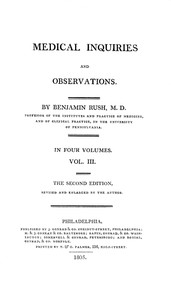
Medical Inquiries and Observations, Vol. 3: The Second Edition, Revised and Enlarged by the Author
Written by Benjamin Rush
Chaptra reads alongside you — AI insights, chapter breakdowns and reader discussions for every book. Join free
About this book
Reading guide
Themes, characters and key ideas in Medical Inquiries and Observations, Vol. 3: The Second Edition, Revised and Enlarged by the Author, written by Chaptra AI.
- about 12 hours
- advanced
- analytical
- didactic
- serious
Benjamin Rush's "Medical Inquiries and Observations, Vol. 3" is a pivotal early 19th-century scientific treatise dedicated to a comprehensive theory of fever. Drawing extensively from his empirical medical practice, Rush posits that various forms of fever originate from a fundamental state of bodily debility, influenced by both natural and unusual stimuli. The volume systematically explores the interplay between debility, excitability, and external triggers, aiming to establish a unified framework for understanding fever's diverse manifestations. Through detailed observations, case studies, and historical context, Rush endeavors to consolidate a coherent and actionable understanding of fever's causes, symptoms, and proposed treatment methods, setting a significant benchmark for medical thought in his era.
“"All fevers are the offspring of the same parent, debility."”
Key themes
- The Unity of Disease
- This is the central philosophical and scientific tenet of Rush's work. He argues that all fevers, and by extension many other diseases, are not distinct entities but rather varied manifestations of a single underlying pathological state: 'debility.' This theme reflects a powerful drive in Enlightenment medicine to find unifying principles and simplify the understanding of complex phenomena.
- Empirical Observation vs. Speculative Theory
- The book exemplifies the tension inherent in early modern science between rigorous observation and the construction of grand, often speculative, theoretical frameworks. Rush meticulously records clinical details from his practice, but these observations are invariably filtered and interpreted through his pre-existing theory of debility and excitability, sometimes leading to confirmation bias rather than genuine inductive reasoning.
- The Body as a System of Excitability
- Central to Rush's physiology is the concept of 'excitability' – the body's inherent capacity to respond to stimuli. He views health as a state of balanced excitability and disease (specifically fever) as a result of either an excess or deficiency of stimuli acting upon an accumulated excitability. This mechanistic view of the body was a dominant paradigm in 18th-century medical thought, influenced by figures like William Cullen.
Worth discussing
How does Rush's unified theory of fever reflect Enlightenment-era scientific thought and its limitations?
Chapter-by-chapter breakdowns, character arcs and the full thematic analysis come with a free account.
Discussions
No one has started one yet
Questions this book opens up
No discussions yet
Be the first to start a discussion about this book!
Sign up to start the discussionReviews
No reviews yet
Be the first to review this book!