
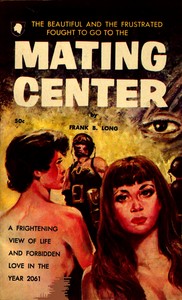
Mating center
Written by Frank Belknap Long
Chaptra reads alongside you — AI insights, chapter breakdowns and reader discussions for every book. Join free
About this book
Reading guide
Themes, characters and key ideas in Mating center, written by Chaptra AI.
- about 8 hours
- intermediate
- dystopian
- rebellious
- provocative
Frank Belknap Long's "The Mating Center" plunges into a chilling 1960s dystopian future where love and sexual attraction are biologically suppressed, leaving reproduction to a select 'sex-privileged' elite. The narrative follows Teleman, a non-privileged construction worker, whose dormant desires are ignited by an encounter with a defiant woman, challenging the oppressive societal norms. As Teleman grapples with these forbidden emotions, he uncovers a burgeoning rebellion against the ruling caste's control over human intimacy. The book explores the profound human cost of such manipulation and the fundamental drive for connection and freedom, setting the stage for a struggle against a system designed to extinguish the very essence of love.
“"Love, as you understand it, is a chaotic inefficiency. We have engineered a more rational, controlled progression for the species."”
Key themes
- Suppression of Love and Desire
- This is the central theme, exploring a society where natural human emotions like love and sexual attraction are biologically and socially engineered out of existence. The novel investigates the profound impact of this suppression on individual identity and collective humanity, and the inherent resilience of these fundamental drives.
- Societal Control and Dystopianism
- The novel portrays a classic dystopian society characterized by extreme governmental control over all aspects of human life, particularly biological functions and personal freedoms. It examines how a regime can maintain power by manipulating not just information, but the very biological makeup and emotional capacity of its citizens.
- Rebellion and Free Will
- This theme explores the human spirit's inherent drive for freedom and autonomy, even in the face of overwhelming oppression. The novel details the gradual formation of a rebellion, sparked by individual acts of defiance, and the struggle to reclaim agency over one's body, mind, and emotions.
Worth discussing
How does the novel explore the concept of love and desire when it is biologically suppressed? What does this suggest about human nature?
Chapter-by-chapter breakdowns, character arcs and the full thematic analysis come with a free account.
Discussions
No one has started one yet
Questions this book opens up
No discussions yet
Be the first to start a discussion about this book!
Sign up to start the discussionReviews
No reviews yet
Be the first to review this book!