
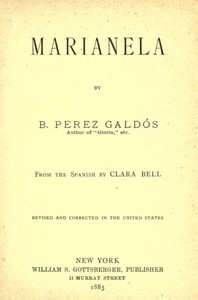
Marianela
Written by Benito Pérez Galdós
Chaptra reads alongside you — AI insights, chapter breakdowns and reader discussions for every book. Join free
About this book
Reading guide
Themes, characters and key ideas in Marianela, written by Chaptra AI.
- about 9 hours
- intermediate
- poignant
- tragic
- philosophical
Benito Pérez Galdós's "Marianela" is a poignant novel set in rural Spain, chronicling the tragic fate of Marianela, a physically unattractive orphan who serves as guide and companion to the blind, wealthy Pablo. Their deep bond, rooted in Pablo's idealized perception of Marianela's inner beauty, is shattered when a renowned ophthalmologist, Teodoro Golfin, restores Pablo's sight. Upon gaining vision, Pablo struggles to reconcile Marianela's physical appearance with the striking beauty of his cousin, Florentina, leading to Marianela's profound despair and ultimate demise. The novel masterfully explores themes of beauty, perception, social neglect, and the harsh realities of a superficial world, cementing its place as a classic of Spanish realism.
“"¡Qué triste es la vida para los que no tienen nadie que les quiera!"”
Key themes
- Inner vs. Outer Beauty
- This is the central theme of the novel, explored through the stark contrast between Marianela's physical unattractiveness and her profound spiritual beauty, and Pablo's initial idealization versus his later superficial judgment. Galdós challenges societal norms that equate physical appearance with worth and happiness.
- Sight and Perception
- The novel critically examines the nature of sight, distinguishing between physical vision and true understanding or perception. Pablo's journey from blindness to sight ironically leads him to a form of spiritual blindness, as his physical eyes prevent him from 'seeing' Marianela's true worth.
- Social Inequality and Neglect
- Galdós uses Marianela's plight to highlight the harsh realities of poverty, the neglect of orphans, and the indifference of society towards its most vulnerable members. Her lack of social standing and physical attractiveness condemns her to a life of hardship and ultimately, a tragic end.
Worth discussing
How does Galdós use the theme of blindness and sight to explore deeper truths about perception and reality?
Chapter-by-chapter breakdowns, character arcs and the full thematic analysis come with a free account.
Discussions
No one has started one yet
Questions this book opens up
No discussions yet
Be the first to start a discussion about this book!
Sign up to start the discussionReviews
No reviews yet
Be the first to review this book!