
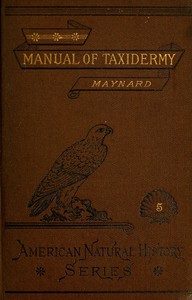
Manual of Taxidermy: A Complete Guide in Collecting and Preserving Birds and Mammals
Written by C. J. (Charles Johnson) Maynard
Chaptra reads alongside you — AI insights, chapter breakdowns and reader discussions for every book. Join free
About this book
Reading guide
Themes, characters and key ideas in Manual of Taxidermy: A Complete Guide in Collecting and Preserving Birds and Mammals, written by Chaptra AI.
- about 8 hours
- intermediate
- instructive
- scientific
- meticulous
C. J. Maynard's "Manual of Taxidermy" is a pivotal late 19th-century scientific publication serving as a comprehensive instructional guide for amateur ornithologists and collectors. It meticulously details the techniques for collecting, preserving, and mounting birds and mammals, reflecting a period of burgeoning interest and evolving methods in taxidermy. The manual's opening establishes its historical context, acknowledging the scarcity of resources for earlier collectors and positioning itself as an essential tool for navigating the craft's challenges. Maynard, drawing on his extensive experience, outlines various capture methods, preservation techniques, and the critical role of anatomical understanding in creating lifelike specimens. Ultimately, the book aims to empower its readers with the knowledge and skills necessary to excel in their ornithological and taxidermy pursuits, bridging the gap between amateur curiosity and professional execution.
“The amateur collector of today faces challenges, but none so daunting as the lack of guidance that plagued our predecessors.”
Key themes
- The Pursuit of Knowledge and Skill
- This theme is central to the manual, emphasizing the journey from amateur interest to professional proficiency. Maynard's work is a direct response to the need for accessible, comprehensive instruction, highlighting the value of acquiring specialized knowledge and mastering a demanding craft. It speaks to the broader Victorian ethos of self-improvement and the democratization of scientific understanding.
- The Evolution of Scientific Practice and Amateur Science
- The manual provides a rich historical context for the development of taxidermy as a scientific and artistic endeavor. It captures a moment when natural history was a popular pursuit, often driven by amateurs, and before modern conservation ethics were fully established. It implicitly traces the professionalization of science from its more eclectic, amateur roots.
- Human Interaction with Nature (Collection and Representation)
- This theme explores the human desire to observe, collect, and represent the natural world. Taxidermy, as presented by Maynard, is a means to bring nature indoors for study and appreciation. It raises questions about the relationship between humans and animals, the ethics of collecting, and the artistic interpretation of natural forms.
Worth discussing
How does Maynard's manual reflect the scientific and ethical standards of the late 19th century regarding animal collection and preservation?
Chapter-by-chapter breakdowns, character arcs and the full thematic analysis come with a free account.
Discussions
No one has started one yet
Questions this book opens up
No discussions yet
Be the first to start a discussion about this book!
Sign up to start the discussionReviews
No reviews yet
Be the first to review this book!