
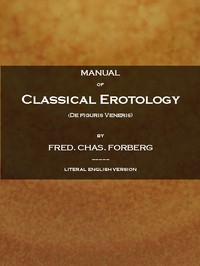
Manual of Classical Erotology (De figuris Veneris)
Written by Unknown author
Chaptra reads alongside you — AI insights, chapter breakdowns and reader discussions for every book. Join free
About this book
Reading guide
Themes, characters and key ideas in Manual of Classical Erotology (De figuris Veneris), written by Chaptra AI.
- about 8 hours
- advanced
- informative
- explicit
- historical
The 'Manual of Classical Erotology (De figuris Veneris)' is a foundational, albeit historically complex and often anonymous, text dedicated to systematically cataloging and describing various sexual acts, positions, and preferences from classical antiquity. It serves as a historical and cultural artifact, providing an unvarnished glimpse into the sexual practices and theories prevalent in ancient Greek and Roman societies. Far from a narrative, this manual functions as an encyclopedic compendium, offering detailed, often clinical, descriptions of the 'figures of Venus' – the manifold expressions of human physical intimacy. Its significance lies in its candid approach to a subject frequently shrouded in taboo, making it an invaluable resource for understanding historical sexuality and the evolution of erotic literature.
“Of the myriad postures consecrated to Venus, the 'Amazonian embrace' permits the woman to dictate the rhythm and depth of the union.”
Key themes
- Human Sexuality and Desire
- This is the core theme, exploring the vast spectrum of human sexual acts, preferences, and the underlying drive of desire. The manual meticulously catalogs various 'figures' of intimacy, treating sexuality as a fundamental and diverse aspect of human experience.
- Historical Perspectives on Sexuality
- This theme explores how sexual norms, practices, and understandings have evolved (or remained consistent) across different historical periods. The manual serves as a primary source, offering a direct, unmediated view into ancient sexual culture, challenging anachronistic assumptions.
- Knowledge and Classification
- The manual's very existence and structure embody the theme of knowledge acquisition and systematic classification. It seeks to document, categorize, and preserve information about sexual practices, treating erotology as a subject worthy of scholarly inquiry and detailed analysis.
Worth discussing
How does 'De figuris Veneris' challenge or confirm modern perceptions of sexuality in classical antiquity?
Chapter-by-chapter breakdowns, character arcs and the full thematic analysis come with a free account.
Discussions
No one has started one yet
Questions this book opens up
No discussions yet
Be the first to start a discussion about this book!
Sign up to start the discussionReviews
No reviews yet
Be the first to review this book!