
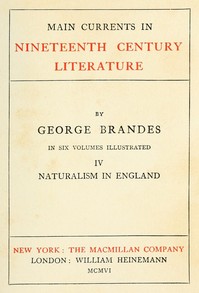
Main Currents in Nineteenth Century Literature - 4. Naturalism in England
Written by Georg Brandes
Chaptra reads alongside you — AI insights, chapter breakdowns and reader discussions for every book. Join free
About this book
Reading guide
Themes, characters and key ideas in Main Currents in Nineteenth Century Literature - 4. Naturalism in England, written by Chaptra AI.
- about 12 hours
- advanced
- analytical
- scholarly
- historical
Georg Brandes's "Main Currents in Nineteenth Century Literature - 4. Naturalism in England" offers a foundational critical analysis of the Naturalistic movement's genesis and development within English literature. Published in the early 20th century, this volume meticulously traces Naturalism's roots from a reaction against Enlightenment classicism, deeply influenced by significant socio-political shifts like the industrial revolution and the war with France. Brandes highlights how these broader European currents fostered a new emphasis on realism, individual experience, and the representation of nature and society in art. He specifically examines the pivotal roles of authors like Wordsworth and Coleridge in breaking from 18th-century literary norms, thereby laying the groundwork for a more 'natural' and socially conscious form of expression that would define the era.
“"The literary shift was not merely an aesthetic choice, but an inevitable consequence of profound societal and political transformations."”
Key themes
- The Evolution of Literary Movements
- Brandes meticulously traces how literary periods are not static but evolve, often as reactions to preceding styles. He demonstrates Naturalism's emergence as a direct counter to 18th-century classicism, highlighting the dynamic and interconnected nature of literary history.
- Influence of Socio-Political Context on Art
- A core argument of Brandes is that literature is profoundly shaped by its historical and societal environment. He links the rise of Naturalism to significant events like the industrial revolution and political upheavals, showing how these external forces compelled a change in artistic focus towards realism and individual experience.
- Realism and the Representation of Nature and Society
- Brandes identifies the embrace of realism and a direct, unvarnished representation of nature and society as a defining characteristic of the emerging Naturalistic impulse. This involved a move away from idealized or stylized portrayals towards a more authentic depiction of the world and human experience.
Worth discussing
How does Brandes define Naturalism, and how does his definition compare to modern understandings of the movement?
Chapter-by-chapter breakdowns, character arcs and the full thematic analysis come with a free account.
Discussions
No one has started one yet
Questions this book opens up
No discussions yet
Be the first to start a discussion about this book!
Sign up to start the discussionReviews
No reviews yet
Be the first to review this book!