
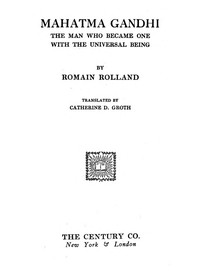
Mahatma Gandhi: The Man Who Became One With the Universal Being
Written by Romain Rolland
Chaptra reads alongside you — AI insights, chapter breakdowns and reader discussions for every book. Join free
About this book
Reading guide
Themes, characters and key ideas in Mahatma Gandhi: The Man Who Became One With the Universal Being, written by Chaptra AI.
- about 8 hours
- intermediate
- uplifting
- inspirational
- philosophical
Romain Rolland's "Mahatma Gandhi: The Man Who Became One With the Universal Being" is a profound biographical exploration of Mohandas Karamchand Gandhi, charting his extraordinary transformation from a modest individual into a global icon of non-violent resistance. The book meticulously details Gandhi's early life, his formative experiences with racism in South Africa, and his subsequent development of the principles of Ahimsa (non-violence) and Satyagraha (truth-force). Rolland portrays Gandhi not merely as a political leader, but as a deeply spiritual figure whose quest for social justice was inextricably linked to his pursuit of universal truth and moral strength. It illuminates how Gandhi's spiritual evolution enabled him to inspire a nation's fight for independence, transcending conventional political narratives to emphasize the power of inner conviction.
“"He who would be one with the Universal Being must be ready to make the greatest sacrifices for the good of all."”
Key themes
- Ahimsa and Non-violent Resistance
- This theme is central to Gandhi's philosophy and is explored as the guiding principle of his life and activism. Ahimsa, meaning non-harm to all living beings, is presented not merely as passive non-resistance but as an active, courageous force for social and political change. Rolland details how Gandhi developed and applied this principle through Satyagraha, confronting injustice without resorting to violence, demonstrating its power against colonial oppression.
- Spiritual Transformation and Self-Realization
- Rolland emphasizes Gandhi's journey as a profound spiritual transformation, where his personal quest for truth (Satya) and self-purification was inextricably linked to his public service. The title itself, 'The Man Who Became One With the Universal Being,' highlights this theme, suggesting that Gandhi's political effectiveness stemmed from his deep spiritual insight and connection to a universal consciousness. His actions were not merely political maneuvers but expressions of a realized spiritual state.
- Justice vs. Oppression
- The book powerfully illustrates Gandhi's relentless quest for justice in the face of systemic oppression, particularly racial discrimination and colonialism. Rolland highlights how Gandhi's personal experiences with injustice fueled his determination to fight for the rights of the marginalized, first in South Africa and then in India. This theme explores the moral imperative to resist oppressive systems and the profound impact of individual courage on collective liberation struggles.
Worth discussing
How does Rolland's portrayal of Gandhi's spiritual journey connect with his political activism?
Chapter-by-chapter breakdowns, character arcs and the full thematic analysis come with a free account.
Discussions
No one has started one yet
Questions this book opens up
No discussions yet
Be the first to start a discussion about this book!
Sign up to start the discussionReviews
No reviews yet
Be the first to review this book!