
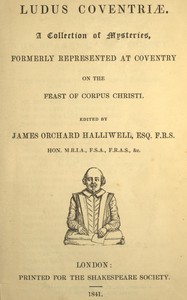
Ludus Coventriæ : $b A collection of mysteries, formerly represented at Coventry on the feast of Corpus Christi
Written by Unknown author
Chaptra reads alongside you — AI insights, chapter breakdowns and reader discussions for every book. Join free
About this book
Reading guide
Themes, characters and key ideas in Ludus Coventriæ : $b A collection of mysteries, formerly represented at Coventry on the feast of Corpus Christi, written by Chaptra AI.
- about 25 hours
- advanced
- religious
- didactic
- dramatic
Ludus Coventriæ, also known as the N-Town Cycle, is a collection of forty-two medieval mystery plays, formerly performed in Coventry on the feast of Corpus Christi. Spanning the entire biblical narrative from the Creation to the Last Judgment, these dramatic works served both as religious instruction and public entertainment for a largely illiterate populace. The cycle presents a comprehensive theological history, emphasizing divine providence, human fallibility, and the redemptive sacrifice of Christ. It stands as a significant example of early English drama, reflecting the religious fervor and social structures of its time while offering insights into medieval interpretations of scripture.
“I am Alpha and Omega, most of might, / All things I made, by my might and hand.”
Key themes
- Salvation and Redemption
- This is the overarching theme of the entire cycle, tracing God's plan from the promise of a redeemer after the Fall to the ultimate sacrifice of Christ and the offer of eternal life. Every play, directly or indirectly, points towards humanity's need for and the divine provision of salvation.
- Divine Justice and Mercy
- The plays consistently explore the dual nature of God's character: His absolute justice in punishing sin (e.g., the Fall, the Flood) and His boundless mercy in offering grace and forgiveness (e.g., the covenant with Noah, the Incarnation). The cycle often contrasts these, showing how mercy ultimately triumphs through Christ.
- Didacticism and Moral Instruction
- A primary purpose of the mystery plays was to instruct the populace in Christian doctrine and moral behavior. The cycle serves as a theological textbook for a largely illiterate audience, conveying complex biblical narratives and moral lessons through accessible, engaging dramatic performance. Every play carries an explicit or implicit moral message.
Worth discussing
How does Ludus Coventriæ reflect the religious beliefs and social structures of medieval England?
Chapter-by-chapter breakdowns, character arcs and the full thematic analysis come with a free account.
Discussions
No one has started one yet
Questions this book opens up
No discussions yet
Be the first to start a discussion about this book!
Sign up to start the discussionReviews
No reviews yet
Be the first to review this book!