
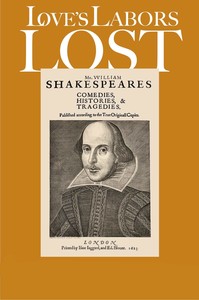
Love's Labour's Lost
Written by William Shakespeare
Chaptra reads alongside you — AI insights, chapter breakdowns and reader discussions for every book. Join free
About this book
Reading guide
Themes, characters and key ideas in Love's Labour's Lost, written by Chaptra AI.
- about 8 hours
- advanced
- humorous
- witty
- romantic
William Shakespeare's "Love's Labour's Lost" is a witty and intellectual early comedy where the King of Navarre and his three lords swear an oath of three years' celibacy and study, only to have their resolve immediately tested by the arrival of the Princess of France and her equally sharp-witted ladies. The play masterfully explores the conflict between ascetic devotion to learning and the irresistible forces of love, leading to a series of elaborate wooing attempts, mistaken identities, and dazzling linguistic sparring. Unlike typical comedies, the play concludes with a year-long deferral of all romantic resolutions, prompting the characters to undertake penance and proving that love, like learning, requires serious effort and sincerity. It stands as a profound exploration of language, oaths, and the journey from youthful idealism to mature understanding.
“Light seeking light doth light of light beguile.”
Key themes
- Love vs. Learning/Asceticism
- This is the central conflict of the play, exploring the tension between intellectual pursuit and natural human desires. The King and his lords vow to dedicate themselves to study and shun women, believing that true wisdom comes from isolation. However, the arrival of the Princess and her ladies quickly proves the futility of such an extreme asceticism, demonstrating that love is an integral part of human experience and a form of learning in itself.
- The Power and Limitations of Language
- The play is a linguistic tour de force, with characters engaging in elaborate wordplay, puns, rhetoric, and classical allusions. Language is presented as both a powerful tool for persuasion, wit, and seduction, and a potential source of deception, affectation, and misunderstanding. It explores how language can be used to construct reality, conceal truth, and express profound emotion, but also how it can become overly ornate, pretentious, and ultimately empty.
- Appearance vs. Reality / Deception and Hypocrisy
- Many characters in the play, particularly the men, present an appearance that contradicts their true intentions or feelings. They initially commit to an ascetic ideal, yet secretly pursue love. Their attempts to woo the ladies often involve disguises and elaborate, insincere declarations. The women, however, are adept at piercing through these facades, exposing the hypocrisy and demanding sincerity.
Worth discussing
How does the play challenge or uphold traditional notions of love and learning?
Chapter-by-chapter breakdowns, character arcs and the full thematic analysis come with a free account.
Discussions
No one has started one yet
Questions this book opens up
No discussions yet
Be the first to start a discussion about this book!
Sign up to start the discussionReviews
No reviews yet
Be the first to review this book!