
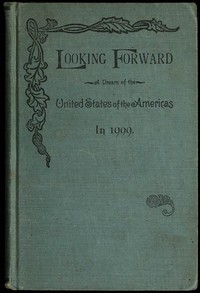
Looking forward : $b a dream of the United States of the Americas in 1999
Written by Arthur Bird
Chaptra reads alongside you — AI insights, chapter breakdowns and reader discussions for every book. Join free
About this book
Reading guide
Themes, characters and key ideas in Looking forward : $b a dream of the United States of the Americas in 1999, written by Chaptra AI.
- about 7 hours
- intermediate
- speculative
- nationalistic
- visionary
Arthur Bird's "Looking Forward: A Dream of the United States of the Americas in 1999" is a late 19th-century speculative political work envisioning a unified Western Hemisphere under the banner of the United States by 1999. The author posits this grand unification as the inevitable fulfillment of America's manifest destiny, guided by its constitution and democratic ideals. Through grandiose language and vivid imagery, Bird personifies America as a benevolent giant, embracing and civilizing the republics of Central and South America. The work sets a tone of ambitious nationalism, projecting a future of peace and prosperity stemming from American influence and governance, while promising to detail the historical unfolding of this transformative political landscape.
“"By 1999, the star-spangled banner flew proudly over every republic, from the frozen North to the fiery South, a testament to destiny's grand design."”
Key themes
- Manifest Destiny and American Exceptionalism
- This theme is the bedrock of Bird's vision, asserting that the expansion and eventual domination of the Western Hemisphere by the United States is not merely an ambition but a divinely ordained and inevitable destiny. It posits American ideals, governance, and culture as inherently superior and destined to civilize and unify the region.
- Political Unification and Imperialism
- Bird explores the concept of hemispheric political unification, but through a lens that implicitly justifies American imperialism. The 'unification' is presented as an absorption of diverse nations under American leadership, rather than a truly egalitarian federation, suggesting a form of benevolent domination.
- Nationalism and Patriotism
- The book is steeped in an ambitious and fervent nationalism, celebrating American identity, power, and destiny. It aims to inspire national pride and loyalty, portraying the envisioned hemispheric empire as the ultimate expression of American greatness and a source of collective self-esteem.
Worth discussing
How does Bird's vision of 'Manifest Destiny' compare to historical interpretations of the concept, and what are its implications?
Chapter-by-chapter breakdowns, character arcs and the full thematic analysis come with a free account.
Discussions
No one has started one yet
Questions this book opens up
No discussions yet
Be the first to start a discussion about this book!
Sign up to start the discussionReviews
No reviews yet
Be the first to review this book!