
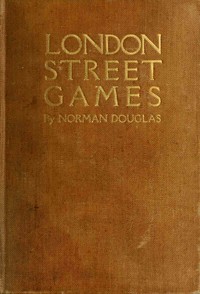
London street games
Written by Norman Douglas
Chaptra reads alongside you — AI insights, chapter breakdowns and reader discussions for every book. Join free
About this book
Reading guide
Themes, characters and key ideas in London street games, written by Chaptra AI.
- about 6 hours
- intermediate
- nostalgic
- observational
- charming
Norman Douglas's "London Street Games" is a fascinating ethnographic catalog of children's play popular in early 20th-century London. The work meticulously documents a wide array of games, from ball-based activities to imaginative non-ball pursuits, highlighting the inherent inventiveness and resourcefulness of children in an urban setting. More than just a list, it offers a nostalgic glimpse into the social dynamics and community involvement fostered by traditional street play. Douglas's observations underscore how these simple, often improvised games were integral to childhood development and socialization, contrasting sharply with the more structured leisure activities of contemporary life. Ultimately, the book serves as a valuable historical record, preserving the memory of a vibrant culture of spontaneous play.
“The streets, far from being mere thoroughfares, were the vibrant, ever-changing stage for the grand drama of childhood.”
Key themes
- The Nature of Play and Childhood Ingenuity
- This theme explores play as a fundamental, innate human activity, particularly in childhood. Douglas highlights how children, despite limited resources, possess an extraordinary capacity for invention, transforming ordinary objects and urban spaces into elaborate playgrounds and rule-bound games. It underscores play as a vital mechanism for creativity, problem-solving, and adapting to one's environment.
- Socialization and Community Building
- The book illustrates how street games serve as crucial arenas for social development and community formation. Children learn vital social skills such as negotiation, cooperation, conflict resolution, and leadership through the shared experience of play. These games foster a sense of belonging and collective identity among participants, often bridging age gaps and social strata within a neighborhood.
- Nostalgia and the Loss of Traditional Play
- Douglas's work is imbued with a sense of nostalgia for a perceived golden age of childhood play. The detailed cataloging implicitly suggests a lament for the fading of these traditional activities in the face of modernization and changing urban landscapes. It explores the idea that certain forms of spontaneous, community-driven play are being lost, replaced by more structured, commercialized, or solitary forms of entertainment.
Worth discussing
How does 'London Street Games' challenge or confirm your understanding of childhood and play in a pre-digital era?
Chapter-by-chapter breakdowns, character arcs and the full thematic analysis come with a free account.
Discussions
No one has started one yet
Questions this book opens up
No discussions yet
Be the first to start a discussion about this book!
Sign up to start the discussionReviews
No reviews yet
Be the first to review this book!