
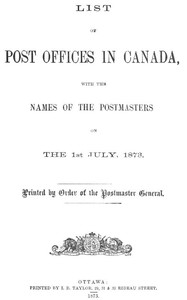
List of Post Offices in Canada, with the Names of the Postmasters ... 1873
Written by Canada. Post Office Department
Chaptra reads alongside you — AI insights, chapter breakdowns and reader discussions for every book. Join free
About this book
Reading guide
Themes, characters and key ideas in List of Post Offices in Canada, with the Names of the Postmasters ... 1873, written by Chaptra AI.
- about 15 hours
- advanced
- Informative
- Historical
- Systematic
“List of Post Offices in Canada, with the Names of the Postmasters ... 1873” is a crucial historical document compiled by the Canada Post Office Department. It meticulously catalogs post office locations across the nascent Canadian nation as of July 1, 1873, alongside the names of their respective postmasters. Beyond a mere directory, this work functions as an official record reflecting Canada's burgeoning national infrastructure and administrative organization shortly after Confederation. Its introductory notes emphasize accuracy and accountability, setting the tone for a comprehensive and systematic compilation that details the geographical spread and human network underpinning the vital postal service of the era. This document offers invaluable insights into the logistical and social fabric of 19th-century Canada.
“List of Post Offices in Canada, with the Names of the Postmasters, as established on the 1st July, 1873.”
Key themes
- National Infrastructure and Connectivity
- This document profoundly illustrates the critical role of the postal service as a foundational national infrastructure. In 1873, communication networks were vital for connecting geographically disparate regions, facilitating governance, commerce, and social cohesion across Canada. The extensive listing of post offices demonstrates the government's deliberate effort to establish and expand these vital links, crucial for solidifying the young nation's identity and administrative control.
- Administrative Organization and Efficiency
- The book serves as a testament to the meticulous administrative organization and bureaucratic efficiency of the Canada Post Office Department. The structured categorization of entries by province, township, and electoral division, coupled with the explicit attention to accuracy (transcriber's note) and continuous improvement (memo for discrepancies), reflects a high degree of administrative sophistication necessary for managing a vast public service in a developing nation.
- Nation-Building and Identity
- The compilation of such a comprehensive national directory shortly after Confederation contributes to the ongoing process of nation-building. By centrally documenting and acknowledging every post office and postmaster, the government was asserting its presence and authority across its territories, fostering a sense of shared national space and collective identity among its disparate communities. It signifies the practical realization of a unified Canadian state.
Worth discussing
How does the meticulous organization of this document reflect the administrative priorities and challenges of post-Confederation Canada?
Chapter-by-chapter breakdowns, character arcs and the full thematic analysis come with a free account.
Discussions
No one has started one yet
Questions this book opens up
No discussions yet
Be the first to start a discussion about this book!
Sign up to start the discussionReviews
No reviews yet
Be the first to review this book!