
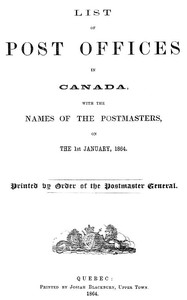
List of Post Offices in Canada, with the Names of the Postmasters ... 1864
Written by Canada. Post Office Department
Chaptra reads alongside you — AI insights, chapter breakdowns and reader discussions for every book. Join free
About this book
Reading guide
Themes, characters and key ideas in List of Post Offices in Canada, with the Names of the Postmasters ... 1864, written by Chaptra AI.
- about 10 hours
- advanced
- informative
- historical
- structured
This 1864 document, compiled by the Canada Post Office Department, is a foundational historical record detailing all active post offices across Canada, along with the names of their respective postmasters. It serves as an invaluable snapshot of the nation's administrative and communication infrastructure during the mid-19th century, just prior to Confederation. Beyond a simple list, it provides insights into geographical settlement patterns, community organization, and the reach of government services. The work is prefaced by administrative notes and directives, emphasizing the importance of accurate record-keeping in a rapidly expanding dominion.
“List of Post Offices in Canada, with the Names of the Postmasters ... 1864”
Key themes
- Communication and Connectivity
- The central theme, highlighting the critical role of the postal system in linking disparate communities and facilitating personal, commercial, and governmental communication across a vast and developing nation. The sheer number and distribution of post offices underscore the imperative for efficient information exchange in 19th-century Canada.
- Nation-building and Governance
- This document serves as tangible evidence of Canada's efforts to establish a coherent national identity and effective governance prior to Confederation. A robust postal system was essential for administrative control, law enforcement, and the dissemination of information from the central government to its citizens across the provinces.
- Administrative Order and Precision
- The meticulous compilation, alphabetical organization, and inclusion of detailed geographical and administrative data reflect a strong emphasis on order, accuracy, and systematic record-keeping. This theme speaks to the bureaucratic rigor and the professionalization of public service in the era.
Worth discussing
What does this document reveal about the state of Canadian infrastructure and administrative organization in 1864?
Chapter-by-chapter breakdowns, character arcs and the full thematic analysis come with a free account.
Discussions
No one has started one yet
Questions this book opens up
No discussions yet
Be the first to start a discussion about this book!
Sign up to start the discussionReviews
No reviews yet
Be the first to review this book!