
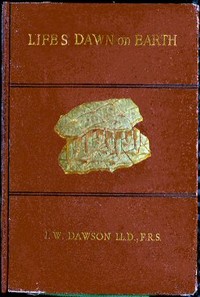
Life's Dawn on Earth: Being the history of the oldest known fossil remains, and their relations to geological time and to the development of the animal kingdom
Written by John William Dawson
Chaptra reads alongside you — AI insights, chapter breakdowns and reader discussions for every book. Join free
About this book
Reading guide
Themes, characters and key ideas in Life's Dawn on Earth: Being the history of the oldest known fossil remains, and their relations to geological time and to the development of the animal kingdom, written by Chaptra AI.
- about 8 hours
- intermediate
- Scientific
- Historical
- Investigative
Sir John William Dawson's "Life's Dawn on Earth" is a late 19th-century scientific work that meticulously documents the discovery and significance of *Eozoon canadense*, a fossil found in Canada's ancient Laurentian rocks. Challenging prevailing beliefs that these primeval formations were devoid of life, Dawson positions *Eozoon* as humanity's earliest known connection to animal life, representing the very origins of the animal kingdom. The book delves into the implications of this discovery for understanding geological time and the evolutionary development of early life forms. Dawson aims to provide a comprehensive yet accessible account, making the profound mysteries of Earth's biological beginnings understandable and engaging for both the scientific community and the general public.
“"In the Laurentian rocks, long deemed barren of life, we find at length the earliest dawn of the animal kingdom, revealing a connection with the primeval past of our globe."”
Key themes
- The Origins of Life
- The most central theme, exploring the fundamental question of how and when life first appeared on Earth. Dawson uses *Eozoon canadense* as a pivotal piece of evidence to push back the perceived timeline of life's emergence, speculating on the conditions and forms of the earliest organisms and their evolutionary relationships.
- Scientific Discovery and Interpretation
- This theme focuses on the process of scientific inquiry itself—the excitement of finding new evidence, the rigorous (for its time) examination of that evidence, and the debates that arise from its interpretation. It highlights how scientific understanding evolves through observation, hypothesis, and peer review.
- Geological Time and Deep History
- The book continually emphasizes the immense scale of Earth's history, using the ancient Laurentian rocks and the discovery of *Eozoon* to impress upon the reader the vastness of geological time. It explores how this deep history shapes our understanding of life's gradual development and the long periods over which evolutionary changes occur.
Worth discussing
How does Dawson's work exemplify the scientific method of the late 19th century, particularly regarding the interpretation of fossil evidence?
Chapter-by-chapter breakdowns, character arcs and the full thematic analysis come with a free account.
Discussions
No one has started one yet
Questions this book opens up
No discussions yet
Be the first to start a discussion about this book!
Sign up to start the discussionReviews
No reviews yet
Be the first to review this book!