
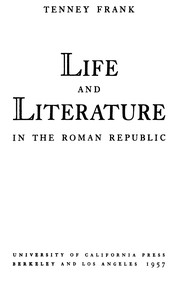
Life and literature in the Roman republic
Written by Tenney Frank
Chaptra reads alongside you — AI insights, chapter breakdowns and reader discussions for every book. Join free
About this book
Reading guide
Themes, characters and key ideas in Life and literature in the Roman republic, written by Chaptra AI.
- about 8 hours
- advanced
- Informative
- Academic
- Analytical
Tenney Frank's "Life and Literature in the Roman Republic" offers a foundational exploration of how Roman literary expression, from its nascent stages, was profoundly shaped by the evolving social, political, and cultural landscape of the Republic. The book challenges earlier scholarship by positing that indigenous Roman self-expression, though initially influenced by Greek forms, developed distinctively in response to unique Roman societal changes. Frank meticulously traces the genesis of early Roman literature, including epic and tragedy, through key figures like Naevius and Ennius, contextualizing their contributions within the broader historical milieu. Ultimately, it argues for a holistic understanding of literature as a direct reflection and product of its creators' contemporary environment.
“"To understand the literature of Rome, one must first understand the life that animated its creation, for Roman letters were never an isolated art but a direct echo of the Republic's pulse."”
Key themes
- The Interplay of Society and Literature
- This is the central thesis of the book: that Roman literature was not an isolated artistic phenomenon but was deeply intertwined with and responsive to the social, political, and cultural developments of the Roman Republic. Frank argues that changes in Roman life directly influenced literary themes, genres, and styles.
- The Emergence of Roman Identity in Literature
- Frank explores how Roman writers, initially influenced by Greek models, gradually forged a distinct Roman literary identity. This theme focuses on the process by which Roman stories, values, and historical experiences found expression through adapted and original literary forms, reflecting a growing sense of national character.
- The Influence and Adaptation of Greek Culture
- While emphasizing Roman distinctiveness, Frank thoroughly analyzes the crucial role of Greek literary forms and cultural contact in stimulating early Roman literature. This theme examines how Roman writers selectively adopted, translated, and adapted Greek genres, meters, and mythological frameworks, transforming them to suit Roman sensibilities and purposes.
Worth discussing
How does Frank's argument challenge or support your preconceived notions about the originality of Roman literature?
Chapter-by-chapter breakdowns, character arcs and the full thematic analysis come with a free account.
Discussions
No one has started one yet
Questions this book opens up
No discussions yet
Be the first to start a discussion about this book!
Sign up to start the discussionReviews
No reviews yet
Be the first to review this book!