
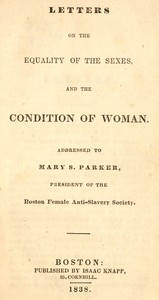
Letters on the equality of the sexes, and the condition of woman
Written by Sarah Grimké
Chaptra reads alongside you — AI insights, chapter breakdowns and reader discussions for every book. Join free
About this book
Reading guide
Themes, characters and key ideas in Letters on the equality of the sexes, and the condition of woman, written by Chaptra AI.
- about 10 hours
- advanced
- earnest
- intellectual
- polemical
Sarah Grimké's "Letters on the Equality of the Sexes, and the Condition of Woman" is a groundbreaking collection of epistolary essays from the early 19th century, passionately advocating for women's moral, intellectual, and spiritual equality. Drawing heavily on biblical scripture, Grimké meticulously deconstructs traditional interpretations used to justify male dominance, arguing instead that men and women were created equal in God's image. She contends that women's subjugation is a product of societal constructs and patriarchal institutions, not divine decree, and calls for women's liberation from these oppressive structures. This work serves as a foundational text in American feminist thought, challenging the prevailing norms of its time and laying essential groundwork for the women's rights movement.
“I ask no favors for my sex. I surrender not our claim to equality. All I ask of our brethren is, that they will take their feet from off our necks, and permit us to stand upright on that ground which God designed us to occupy.”
Key themes
- Gender Equality and Women's Rights
- This is the central theme of the work, with Grimké arguing for the inherent moral, intellectual, and spiritual equality of men and women. She contends that any perceived inferiority of women is a construct of society, not a divine decree, and advocates for their full participation in public and private life.
- Biblical Interpretation and Re-contextualization
- Grimké meticulously challenges traditional, patriarchal interpretations of biblical texts, particularly those from Genesis and the Pauline epistles, which were historically used to justify male dominance. She argues for a reading that emphasizes equality, justice, and the spirit of Christian teachings over literal, often misogynistic, interpretations.
- Societal Oppression and Patriarchal Structures
- Grimké directly critiques the legal, educational, professional, and social structures of her time that confined women to a subordinate status. She argues that these limitations are not natural or divinely ordained but are rather artificial constructs designed to maintain male power and privilege.
Worth discussing
How does Grimké's use of biblical scripture strengthen or weaken her arguments for a modern audience?
Chapter-by-chapter breakdowns, character arcs and the full thematic analysis come with a free account.
Discussions
No one has started one yet
Questions this book opens up
No discussions yet
Be the first to start a discussion about this book!
Sign up to start the discussionReviews
No reviews yet
Be the first to review this book!