
The AI reading companion for people who take books seriously
AI insights, chapter breakdowns, community discussions — all in one place.
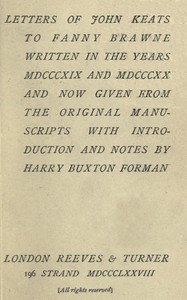
Letters of John Keats to Fanny Brawne: Written in the years MDCCCXIX and MDCCCXX and now given from the original manuscripts
About this book
More by John Keats
Browse all books by this authorExplore Poets, English Books
Discover more Poets, English literature
Click "Read now" to open in our Reader with AI features.
Community Discussions
Join the conversation about this book
Discussions
0 discussions
No discussions yet
Be the first to start a discussion about this book!
Sign up to start the discussionAI-Powered Insights
A clearer way to understand Letters of John Keats to Fanny Brawne: Written in the years MDCCCXIX and MDCCCXX and now given from the original manuscripts through themes, characters, and key ideas
This reading guide highlights what stands out in Letters of John Keats to Fanny Brawne: Written in the years MDCCCXIX and MDCCCXX and now given from the original manuscripts through 5 core themes, 2 character profiles. It is meant to help readers decide whether the book fits their taste and deepen the reading once they begin.
About this book
A quick AI guide to “Letters of John Keats to Fanny Brawne: Written in the years MDCCCXIX and MDCCCXX and now given from the original manuscripts”
Get the shape of the book before you commit: what it is about, what mood it carries, and what ideas readers tend to stay with afterward.
What the book is doing
John Keats's 'Letters to Fanny Brawne' offers an intensely intimate and poignant glimpse into the renowned poet's heart and mind during the final years of his life. This collection chronicles his passionate, often turbulent, relationship with Fanny Brawne, revealing the depths of his love, his profound emotional struggles, and the pervasive shadow of his deteriorating health. Through these personal correspondences, readers witness Keats grappling with artistic ambition, financial insecurity, and the crushing fear of separation and mortality, creating a powerful testament to enduring affection in the face of inevitable tragedy. The letters serve as a vital biographical document, illuminating the human cost of genius and the complexities of romantic devotion.
Key Themes
Love and Passion
The central and most pervasive theme, exploring the overwhelming, consuming, and often tormenting nature of Keats's love for Fanny Brawne. It delves into the ecstasy, jealousy, longing, and despair that characterize intense romantic devotion, particularly when faced with external obstacles and internal insecurities. Keats's love is depicted as a force that both inspires and distracts, dominating his thoughts and feelings to the exclusion of almost all else.
Mortality and Illness
The pervasive shadow cast over the entire correspondence. Keats's struggle with tuberculosis and the awareness of his impending death profoundly shapes his emotional state, his relationship with Fanny, and his outlook on life and art. This theme explores the fragility of human life, the fear of oblivion, and the desperate desire for love and connection in the face of inevitable loss. It highlights how physical suffering can intensify emotional experience and alter priorities.
“I cannot exist without you—I am forgetful of everything but seeing you again—my life seems to stop there—I see no further. You have absorb'd me.”
How do Keats's letters challenge or reinforce traditional notions of romantic love?
See chapter-by-chapter takeaways, deeper character arcs, and a fuller literary analysis built around this book.
Unlock full AI analysis for “Letters of John Keats to Fanny Brawne: Written in the years MDCCCXIX and MDCCCXX and now given from the original manuscripts”
Chapter breakdowns, character deep-dives, and thematic analysis — all in one place.
Reader Reviews
See what others are saying
Reviews
Overall Rating
Based on community ratings
No reviews yet
Be the first to review this book!
Readers Also Enjoyed
Discover more books similar to Letters of John Keats to Fanny Brawne: Written in the years MDCCCXIX and MDCCCXX and now given from the original manuscripts