
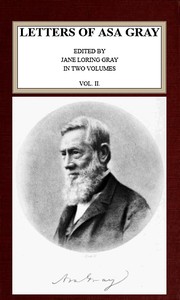
About this book
Read it with a club
Small groups reading the same books and talking as they go.


News
- 4 members
- 1,813 discussions
- Active Sep 11
Read Letters of Asa Gray; Vol. 2 alongside people who are reading it too.
Also here: News Bulletin, Just Joking....
Chaptra Prime — paid clubs, every club feature, and unlimited reading support, for $5 a month or $60 once.
See PrimeReading guide
Themes, characters and key ideas in Letters of Asa Gray; Vol. 2, written by Chaptra AI.
- about 18 hours
- advanced
- Informative
- Reflective
- Scholarly
Letters of Asa Gray; Vol. 2 compiles the extensive personal and scientific correspondence of Dr. Asa Gray, a pivotal American botanist, primarily spanning his second European journey from 1850 to 1859. This volume offers an intimate glimpse into Gray's life, travels with his wife, and profound engagement with the botanical world, capturing the intellectual spirit of the late 19th century. Through his letters, Gray details his explorations of European botanical gardens, meetings with eminent scientific contemporaries like Mr. Hooker and Mr. Brown, and his reflections on landscapes and scientific discourse. The collection serves as a vital historical document, illustrating the interconnectedness of global scientific communities and the personal dedication required for scientific advancement during this era. It paints a vivid picture of a botanist's life, blending personal observations with rigorous scientific inquiry.
“The botanical treasures I've encountered here in England are truly beyond expectation, a testament to nature's boundless ingenuity.”
Key themes
- The Pursuit of Scientific Knowledge
- This is the overarching theme, as Gray's letters are fundamentally driven by his insatiable curiosity and dedication to advancing botanical science. Every journey, meeting, and observation is filtered through the lens of scientific inquiry, from plant classification to understanding biodiversity. The volume exemplifies the rigorous, persistent, and collaborative nature of scientific discovery in the 19th century.
- The Natural World and Botany
- The intrinsic subject matter of the book is the natural world, specifically botany. Gray's letters are a testament to the beauty, complexity, and scientific significance of plant life. They reflect a deep reverence for nature and an intense commitment to its systematic study, contributing to the understanding of global flora.
- Travel and Exploration as Scientific Endeavor
- Gray's European journey is not merely personal tourism but an integral part of his scientific work. The letters demonstrate how physical travel, observation of diverse landscapes, and access to international collections were critical for botanical research during this period, expanding his empirical data and facilitating global scientific exchange.
Worth discussing
How does the epistolary format enhance or limit our understanding of Asa Gray's scientific work and personal life?
Chapter-by-chapter breakdowns, character arcs and the full thematic analysis come with a free account.
Discussions
No one has started one yet
Questions this book opens up
No discussions yet
Be the first to start a discussion about this book!
Sign up to start the discussionReviews
No reviews yet
Be the first to review this book!