
About this book
Read it with a club
Small groups reading the same books and talking as they go.


News
- 4 members
- 1,813 discussions
- Active Sep 11
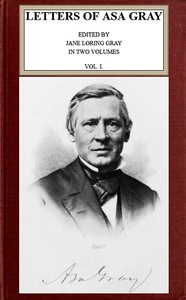
Read Letters of Asa Gray; Vol. 1 alongside people who are reading it too.
Also here: News Bulletin, Just Joking....
Chaptra Prime — paid clubs, every club feature, and unlimited reading support, for $5 a month or $60 once.
See PrimeReading guide
Themes, characters and key ideas in Letters of Asa Gray; Vol. 1, written by Chaptra AI.
- about 10 hours
- advanced
- scholarly
- reflective
- intellectual
Letters of Asa Gray; Vol. 1 presents a fascinating collection of correspondence from one of America's most influential botanists and naturalists, Asa Gray. This volume chronicles his early career, scientific explorations, and profound intellectual exchanges with leading figures of the 19th century, most notably Charles Darwin. Through his letters, Gray reveals the intricate process of scientific discovery, the challenges of establishing botany as a rigorous discipline in America, and his personal struggle to reconcile emerging scientific theories, particularly Darwinian evolution, with his deep religious faith. The book offers an unparalleled window into the scientific and intellectual landscape of the mid-19th century, illustrating the collaborative and often contentious nature of scientific progress.
“"I have been so busy with these Darwinian discussions that I have almost forgotten I am a botanist."”
Key themes
- Science and Religion
- This is arguably the most prominent theme. Gray, a devout Christian, grappled extensively with reconciling Darwinian evolution with his belief in a divine creator. His letters meticulously detail his arguments for a 'theistic evolution,' where natural selection operates under an overarching divine design, demonstrating a profound intellectual effort to harmonize scientific discovery with spiritual conviction. This theme reflects a major intellectual struggle of the 19th century and remains relevant today.
- The Nature of Scientific Inquiry
- The letters offer an intimate look into the scientific method as practiced in the 19th century. Gray's correspondence reveals the painstaking process of observation, collection, classification, hypothesis formation, and peer review (through letter exchanges). It highlights the collaborative and often iterative nature of scientific progress, where ideas are shared, critiqued, and refined over time through dialogue with colleagues across the globe.
- Intellectual Exchange and Collaboration
- Gray's letters vividly illustrate the critical role of correspondence in facilitating intellectual exchange and collaboration among scientists before modern communication technologies. His network spanned continents, allowing for the sharing of specimens, data, theories, and critiques. This theme underscores how scientific knowledge is built not in isolation, but through a vibrant, global community of scholars challenging and supporting one another.
Worth discussing
How do Asa Gray's letters illustrate the process of scientific discovery and debate in the 19th century?
Chapter-by-chapter breakdowns, character arcs and the full thematic analysis come with a free account.
Discussions
No one has started one yet
Questions this book opens up
No discussions yet
Be the first to start a discussion about this book!
Sign up to start the discussionReviews
No reviews yet
Be the first to review this book!