
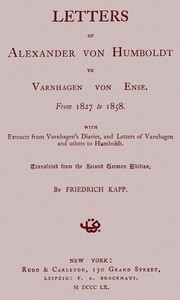
Letters of Alexander von Humboldt to Varnhagen von Ense.: From 1827 to 1858. With extracts from Varnhagen's diaries, and letters of Varnhagen and others to Humboldt
Written by Alexander von Humboldt
Chaptra reads alongside you — AI insights, chapter breakdowns and reader discussions for every book. Join free
About this book
Reading guide
Themes, characters and key ideas in Letters of Alexander von Humboldt to Varnhagen von Ense.: From 1827 to 1858. With extracts from Varnhagen's diaries, and letters of Varnhagen and others to Humboldt, written by Chaptra AI.
- about 20 hours
- advanced
- Intellectual
- Historical
- Reflective
This collection, "Letters of Alexander von Humboldt to Varnhagen von Ense," offers a unique glimpse into the intellectual life and profound friendship between the pioneering scientist Alexander von Humboldt and the critic Karl August Varnhagen von Ense, spanning over three decades from 1827 to 1858. Through their candid correspondence, readers witness Humboldt's ongoing scientific endeavors, his reflections on the natural world and human society, and the intricate network of intellectual exchange characteristic of the 19th century. The inclusion of Varnhagen's diary entries and letters from others enriches the narrative, providing context and diverse perspectives on Humboldt's multifaceted legacy. It serves as an invaluable primary source for understanding Humboldt's contributions to science, literature, and the sociopolitical landscape of his time, framed by a significant personal connection.
“"Everywhere the trace of a thoughtful connection, an order, a harmony, is visible in the phenomena of nature."”
Key themes
- Intellectual Friendship and Exchange
- The enduring and profound bond between Humboldt and Varnhagen forms the emotional and structural core of the collection. Their correspondence exemplifies a friendship built on mutual respect, shared intellectual curiosity, and candid exchange, highlighting the importance of such relationships for intellectual development and support in the 19th century.
- Scientific Inquiry and the Unity of Nature (Kosmos)
- Humboldt's relentless pursuit of knowledge and his overarching 'Kosmos' vision—the idea that all natural phenomena are interconnected and can be understood as a unified whole—is a dominant theme. The letters detail his scientific observations, theories, and the process of synthesizing vast amounts of information across disciplines.
- Social and Political Commentary
- Beyond science, Humboldt's letters offer sharp critiques and observations on the sociopolitical landscape of 19th-century Prussia and Europe. He frequently comments on issues of governance, censorship, social inequality, and the burgeoning changes in society, often expressing liberal views.
Worth discussing
How does the epistolary format enhance or hinder the reader's understanding of Humboldt's intellectual journey and personal life?
Chapter-by-chapter breakdowns, character arcs and the full thematic analysis come with a free account.
Discussions
No one has started one yet
Questions this book opens up
No discussions yet
Be the first to start a discussion about this book!
Sign up to start the discussionReviews
No reviews yet
Be the first to review this book!