
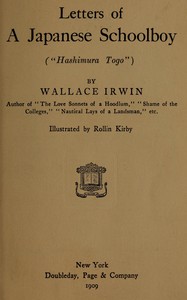
Letters of a Japanese schoolboy ("Hashimura Togo")
Written by Wallace Irwin
Chaptra reads alongside you — AI insights, chapter breakdowns and reader discussions for every book. Join free
About this book
Read it with a club
Chaptra's fiction clubs — small groups reading the same books and talking as they go.


CraxMe Readers Book Club
Fiction
- 385 members
- 227 discussions
- Started December 2025
Welcome to the Readers Book Club. This is an informal group for like-minded people, where you can discuss books, share and recommend, track your reading progress, and lots more. Discuss Books — all about books. Discuss a particular book or genre, share your favourite quotes. Book Reviews — loved a book and highly recommend it? Or was it just average? Share your review and discuss with fellow readers. (May contain spoilers.) Group Reads — what is a book club without a group read! Buddy Reads — planning to read a book and looking for someone to read it with? Post in the Buddy Read request thread, find a reading buddy, and start discussing.
Read Letters of a Japanese schoolboy ("Hashimura Togo") alongside people who are reading it too.
Also here: Doorstops, First Lines Club
Chaptra Prime — paid clubs, every club feature, and unlimited reading support, for $5 a month or $60 once.
See PrimeReading guide
Themes, characters and key ideas in Letters of a Japanese schoolboy ("Hashimura Togo"), written by Chaptra AI.
- about 7 hours
- intermediate
- humorous
- satirical
- insightful
Wallace Irwin's "Letters of a Japanese Schoolboy" introduces Hashimura Togo, a 35-year-old Japanese immigrant navigating early 20th-century America through a series of humorous letters to a New York newspaper editor. Togo's unique, grammatically unconventional English provides a satirical lens through which he observes and critiques American culture, politics, and social customs, often highlighting significant cultural misunderstandings. Despite his admiration for the 'Noble Allies' concept, Togo frequently encounters prejudice and economic hardship, which he recounts with a blend of naiveté, resilience, and sharp wit. The book thus serves as both a comedic social commentary and a poignant exploration of the immigrant experience, using humor to address serious issues of identity and belonging.
“"Hon. Editor, I am Hashimura Togo, Japanese schoolboy, 35 year old, and I have come to America to learn the English and be a citizen, but America is very strange place."”
Key themes
- Cultural Misunderstanding and Clash
- This is the central theme, explored through Togo's humorous and often frustrating encounters with American customs, language, and social norms. His literal interpretations and unique phrasing highlight the profound differences between his Japanese background and his new environment, often leading to comedic situations that underscore deeper societal disconnections.
- Immigration and Assimilation
- The book deeply explores the immigrant experience in early 20th-century America through Togo's attempts to understand and integrate into a new society. It showcases the hopes, hardships, and identity struggles faced by those seeking a new life, contrasting the ideal of the 'melting pot' with the reality of resistance and prejudice.
- Satire of American Society and Politics
- Irwin uses Togo's innocent, outsider perspective as a powerful tool to satirize various aspects of American life. From the perceived hypocrisy of politicians and the excesses of capitalism to the superficiality of social conventions, Togo's observations expose the absurdities and contradictions within American culture.
Worth discussing
How does Irwin use humor and satire to critique American society in the early 20th century?
Chapter-by-chapter breakdowns, character arcs and the full thematic analysis come with a free account.
Discussions
No one has started one yet
Questions this book opens up
No discussions yet
Be the first to start a discussion about this book!
Sign up to start the discussionReviews
No reviews yet
Be the first to review this book!