
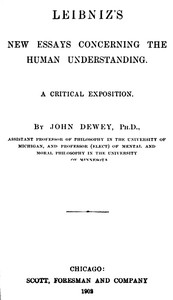
Leibniz's New Essays Concerning the Human Understanding: A Critical Exposition
Written by John Dewey
Chaptra reads alongside you — AI insights, chapter breakdowns and reader discussions for every book. Join free
About this book
Reading guide
Themes, characters and key ideas in Leibniz's New Essays Concerning the Human Understanding: A Critical Exposition, written by Chaptra AI.
- about 15 hours
- advanced
- analytical
- academic
- intellectual
John Dewey's "Leibniz's New Essays Concerning the Human Understanding: A Critical Exposition" is a late 19th-century philosophical treatise that meticulously dissects and interprets Gottfried Wilhelm Leibniz's seminal work, "Nouveaux Essais." Dewey critically engages with Leibniz's rationalist philosophy, particularly his theories on human understanding, contrasting them with the empiricist views of John Locke. The exposition begins with a comprehensive biographical sketch of Leibniz, tracing his intellectual development and the influences that shaped his quest for a unified understanding of the universe. Dewey aims to bridge historical philosophy with contemporary discussions, highlighting Leibniz's enduring relevance to modern thought and providing a foundational analysis for deeper philosophical inquiry.
“"Leibniz's genius lay in his systematic attempt to reconcile the seemingly disparate realms of mechanistic science and teleological metaphysics."”
Key themes
- Rationalism vs. Empiricism
- This is the central philosophical tension explored. Dewey meticulously analyzes Leibniz's rationalist defense of innate ideas and necessary truths, directly contrasting it with Locke's empiricist assertion that all knowledge derives from sensory experience. The exposition delves into the nuances of each position, highlighting their strengths and weaknesses in accounting for human understanding.
- The Foundations of Human Understanding
- The core subject matter of both Leibniz's original work and Dewey's exposition. This theme explores how humans acquire knowledge, the nature of ideas, the role of reason and experience, and the limits of human cognition. Dewey's analysis unpacks Leibniz's systematic attempt to provide a robust metaphysical and epistemological basis for understanding.
- Historical Context and Philosophical Evolution
- Dewey emphasizes the importance of understanding philosophical ideas within their historical and intellectual context. He traces Leibniz's development, highlighting how his personal experiences, scientific pursuits, and engagements with contemporary thinkers shaped his philosophical system. This theme underscores that philosophy is not static but evolves through dialogue and critique across generations.
Worth discussing
How does Dewey's biographical sketch of Leibniz enhance our understanding of his philosophical system?
Chapter-by-chapter breakdowns, character arcs and the full thematic analysis come with a free account.
Discussions
No one has started one yet
Questions this book opens up
No discussions yet
Be the first to start a discussion about this book!
Sign up to start the discussionReviews
No reviews yet
Be the first to review this book!