
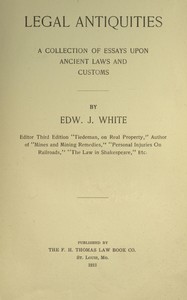
Legal antiquities : $b A collection of essays upon ancient laws and customs
Written by Edward J. (Edward Joseph) White
Not rated yet — tap a star to review it
Chaptra reads alongside you — AI insights, chapter breakdowns and reader discussions for every book. Join free
About this book
"Legal Antiquities: A Collection of Essays upon Ancient Laws and Customs" by White is a scholarly collection of historical essays written in the early 20th century. The book explores the development and peculiarities of ancient legal systems, primarily focusing on Anglo-Saxon and English law, with occasional references to Roman and other traditions. Its main topic is the evolution of various legal institutions and customs—ranging from marriage laws to trial by ordeal and witchcraft—exploring how these practices shaped and reflected the societies that created them. The opening of "Legal Antiquities" offers a comprehensive introduction that situates the study of old laws and customs within the context of the rapid changes and restlessness of modern (early 20th-century) society. The author advocates for a thoughtful examination of legal history to avoid blindly discarding valuable traditions or repeating past mistakes, underlining the need for a careful balance between reform and preservation. Chapter I begins with an in-depth survey of marriage laws and customs, tracing their origins from early tribal societies through Roman and Hebrew practices, up to medieval and early modern England. It details the evolution of marriage forms (monogamy, polygamy, polyandry), related customs such as dowries and wedding rings, legal implications, and strange traditions like "smock-marriages." The text consistently ties legal developments to social change, emphasizing the historical contingency and cultural diversity of the laws shaping personal relationships.
Reading guide
Themes, characters and key ideas in Legal antiquities : $b A collection of essays upon ancient laws and customs, written by Chaptra AI.
A reading guide for this book hasn't been written yet. Chaptra builds one the first time a reader opens it.
Chapter-by-chapter breakdowns, character arcs and the full thematic analysis come with a free account.
Discussions
No one has started one yet
No discussions yet
Be the first to start a discussion about this book!
Sign up to start the discussionReviews
No reviews yet
Be the first to review this book!