
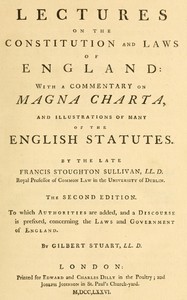
Lectures on the constitution and laws of England: With a commentary on Magna Charta, and illustrations of many of the English statutes
Written by Francis Stoughton Sullivan
Chaptra reads alongside you — AI insights, chapter breakdowns and reader discussions for every book. Join free
About this book
Reading guide
Themes, characters and key ideas in Lectures on the constitution and laws of England: With a commentary on Magna Charta, and illustrations of many of the English statutes, written by Chaptra AI.
- about 30 hours
- advanced
- informative
- analytical
- scholarly
Francis Stoughton Sullivan's "Lectures on the constitution and laws of England" provides a systematic and comprehensive exposition of English constitutional and common law, delivered originally as academic lectures. Published posthumously, the work meticulously examines the historical evolution of legal principles, offering a detailed commentary on foundational documents like Magna Charta and illustrating numerous English statutes. It serves as a significant 18th-century contribution to legal education, aiming to clarify the intricate framework of English jurisprudence for students and scholars alike. Sullivan's lectures trace the origins and development of key legal concepts, making complex legal history accessible and understandable and paving the way for later systematic legal commentaries.
“The Constitution of England is a mixed one, compounded of Monarchy, Aristocracy, and Democracy.”
Key themes
- The Rule of Law
- Sullivan consistently emphasizes that English governance is founded on established laws, not arbitrary power. He illustrates how common law, statutes, and constitutional principles work together to create a predictable and just legal framework, where all, including the sovereign, are subject to the law.
- Constitutionalism and Limited Government
- Sullivan explores the structure of the English constitution, highlighting the balance of powers among the monarchy, Parliament, and the judiciary. He argues for a government whose authority is circumscribed by law and tradition, preventing tyranny and protecting individual liberties.
- Historical Development of Law
- A core aspect of Sullivan's methodology is tracing legal concepts and institutions through their historical evolution. He demonstrates that English law is not static but a dynamic system shaped by centuries of customs, judicial decisions, and legislative acts, from Anglo-Saxon times through the Norman Conquest and beyond.
Worth discussing
How do Sullivan's 'Lectures' compare with Blackstone's 'Commentaries' in terms of scope, methodology, and influence on legal education?
Chapter-by-chapter breakdowns, character arcs and the full thematic analysis come with a free account.
Discussions
No one has started one yet
Questions this book opens up
No discussions yet
Be the first to start a discussion about this book!
Sign up to start the discussionReviews
No reviews yet
Be the first to review this book!