
The AI reading companion for people who take books seriously
AI insights, chapter breakdowns, community discussions — all in one place.
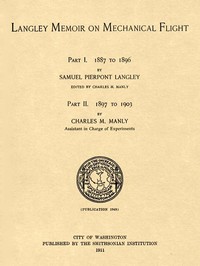
Langley Memoir on Mechanical Flight, Parts I and II: Smithsonian Contributions to Knowledge, Volume 27 Number 3, Publication 1948, 1911
About this book
More by S. P. (Samuel Pierpont) Langley
Browse all books by this authorExplore Aeronautics Books
Discover more Aeronautics literature
Click "Read now" to open in our Reader with AI features.
Community Discussions
Join the conversation about this book
Discussions
0 discussions
No discussions yet
Be the first to start a discussion about this book!
Sign up to start the discussionAI-Powered Insights
A clearer way to understand Langley Memoir on Mechanical Flight, Parts I and II: Smithsonian Contributions to Knowledge, Volume 27 Number 3, Publication 1948, 1911 through themes, characters, and key ideas
This reading guide highlights what stands out in Langley Memoir on Mechanical Flight, Parts I and II: Smithsonian Contributions to Knowledge, Volume 27 Number 3, Publication 1948, 1911 through 4 core themes, 2 character profiles. It is meant to help readers decide whether the book fits their taste and deepen the reading once they begin.
About this book
A quick AI guide to “Langley Memoir on Mechanical Flight, Parts I and II: Smithsonian Contributions to Knowledge, Volume 27 Number 3, Publication 1948, 1911”
Get the shape of the book before you commit: what it is about, what mood it carries, and what ideas readers tend to stay with afterward.
What the book is doing
Samuel Pierpont Langley's 'Memoir on Mechanical Flight, Parts I and II,' co-authored with Charles M. Manly, meticulously chronicles the pioneering scientific and engineering endeavors in early aerodynamics from 1887 to 1896. It details Langley's iterative process of designing, constructing, and testing various aerodromes, from rubber-powered models to more powerful steam-engine prototypes. The memoir highlights the significant technical challenges faced, such as weight, stability, and launching mechanics, alongside the rigorous scientific inquiry applied to overcome them. It stands as a vital historical document, illustrating the nascent stages of sustained aerial transportation and the relentless pursuit of flight technology during a transformative era.
Key Themes
Scientific Inquiry and Method
The memoir is a testament to the rigorous application of the scientific method in a burgeoning field. It showcases the process of observation, hypothesis formation, systematic experimentation, data collection, analysis of results (both successes and failures), and iterative refinement of theories and designs. This theme is central to the entire work, driving the narrative of discovery.
The Dawn of Aviation and Technological Progress
The memoir provides a critical snapshot of the historical moment when mechanical flight transitioned from a theoretical dream to a practical possibility. It documents the state of the art in late 19th-century aeronautical engineering, showcasing the specific technological hurdles that needed to be overcome and the nascent solutions being developed, thus charting the very beginning of the aviation age.
“The problems of mechanical flight, once considered chimerical, are now yielding to patient scientific inquiry.”
How does Langley's methodical approach exemplify the scientific method in a nascent field of study?
See chapter-by-chapter takeaways, deeper character arcs, and a fuller literary analysis built around this book.
Unlock full AI analysis for “Langley Memoir on Mechanical Flight, Parts I and II: Smithsonian Contributions to Knowledge, Volume 27 Number 3, Publication 1948, 1911”
Chapter breakdowns, character deep-dives, and thematic analysis — all in one place.
Reader Reviews
See what others are saying
Reviews
Overall Rating
Based on community ratings
No reviews yet
Be the first to review this book!
Readers Also Enjoyed
Discover more books similar to Langley Memoir on Mechanical Flight, Parts I and II: Smithsonian Contributions to Knowledge, Volume 27 Number 3, Publication 1948, 1911