
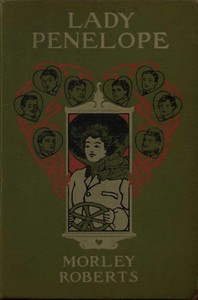
Lady Penelope
Written by Morley Roberts
Chaptra reads alongside you — AI insights, chapter breakdowns and reader discussions for every book. Join free
About this book
Reading guide
Themes, characters and key ideas in Lady Penelope, written by Chaptra AI.
- about 8 hours
- intermediate
- humorous
- witty
- rebellious
Morley Roberts' "Lady Penelope" introduces Lady Penelope Brading, a vibrant young woman of the early 20th century, who, upon her twenty-first birthday, boldly declares her mission to reform society, specifically targeting the perceived selfishness of men and the restrictive norms surrounding marriage and gender roles. The narrative sets her against the backdrop of traditional expectations, embodied by her meek cousin Ethel and overbearing aunt Titania. Blending sharp social commentary with humor, the novel chronicles Penelope's revolutionary spirit and her dynamic interactions with a host of suitors, whom she dismissively labels her "horde." It explores her quest for personal freedom and individualism amidst the societal pressures of her time, promising a witty and engaging critique of established conventions.
“"I refuse to be a mere ornament in a drawing-room; my life's purpose is to mend the broken fabric of society!" (Illustrative)”
Key themes
- Societal Reform and Individualism
- The core theme of the novel, exploring Lady Penelope's dedicated mission to challenge and reshape the perceived flaws in society, particularly concerning gender roles and the institution of marriage. This theme delves into the courage required for an individual to stand against collective norms and pursue a vision of a better, more equitable world.
- Gender Roles and Female Agency
- The novel directly confronts the restrictive gender roles imposed on women in the early 20th century. Penelope's character is a powerful exploration of female agency, as she actively rejects the traditional path of marriage and domesticity in favor of a life dedicated to intellectual and social pursuits, advocating for women's right to define their own purpose.
- Tradition vs. Modernity
- This theme highlights the conflict between the entrenched customs and values of the older generation (represented by Aunt Titania) and the progressive, forward-thinking ideals of the younger generation (embodied by Penelope). It explores the friction that arises when new ideas challenge long-held beliefs and practices, particularly during a period of significant social change.
Worth discussing
How does Lady Penelope challenge the societal expectations of women in the early 20th century, and how relevant are these challenges today?
Chapter-by-chapter breakdowns, character arcs and the full thematic analysis come with a free account.
Discussions
No one has started one yet
Questions this book opens up
No discussions yet
Be the first to start a discussion about this book!
Sign up to start the discussionReviews
No reviews yet
Be the first to review this book!