
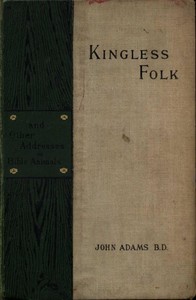
Kingless Folk, and Other Addresses on Bible Animals
Written by John Adams
Chaptra reads alongside you — AI insights, chapter breakdowns and reader discussions for every book. Join free
About this book
Reading guide
Themes, characters and key ideas in Kingless Folk, and Other Addresses on Bible Animals, written by Chaptra AI.
- about 6 hours
- intermediate
- Didactic
- Inspirational
- Reflective
John Adams's "Kingless Folk, and Other Addresses on Bible Animals" is a late 19th-century collection of religious discourses that utilizes the natural world, specifically animals mentioned in the Bible, as a pedagogical tool for moral and spiritual instruction. Each address examines a particular animal, drawing parallels between its characteristics or behaviors and essential virtues such as diligence, foresight, and self-reliance. The work aims to impart valuable life lessons, particularly for young readers, by making biblical wisdom accessible and relatable through the allegorical power of nature. Adams's approach transforms creatures like the ant into vivid metaphors, establishing a framework for personal development and ethical conduct rooted in scriptural teachings.
“Observe the ant, thou sluggard; consider her ways, and be wise. For she, having no guide, overseer, or ruler, provideth her meat in the summer, and gathereth her food in the harvest.”
Key themes
- Hard Work and Diligence
- This is a cornerstone theme, most explicitly developed through the example of the ant. Adams emphasizes that consistent, tireless effort is not only a virtue but a necessary component for success and spiritual well-being. It is presented as a divinely sanctioned principle, with biblical support.
- Moral Instruction Through Nature
- This is the overarching premise of the entire book. Adams posits that the natural world, particularly the animal kingdom as depicted in the Bible, serves as a living textbook for moral and spiritual lessons. God's wisdom is not only in scripture but also observable in the characteristics and behaviors of His creation, providing tangible examples for human conduct.
- Self-Reliance and Foresight
- Closely linked with diligence, this theme highlights the importance of individuals taking responsibility for their own future and well-being. Foresight involves planning and preparing for future needs, while self-reliance emphasizes internal motivation and capability rather than external dependence. The ant, working without an 'overseer,' is the prime example.
Worth discussing
How effective is the use of animal metaphors in conveying moral and spiritual lessons, and why?
Chapter-by-chapter breakdowns, character arcs and the full thematic analysis come with a free account.
Discussions
No one has started one yet
Questions this book opens up
No discussions yet
Be the first to start a discussion about this book!
Sign up to start the discussionReviews
No reviews yet
Be the first to review this book!