
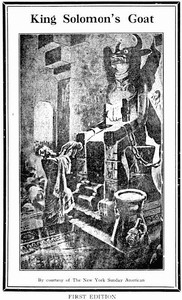
King Solomon's Goat
Written by George Willard Bartlett
Chaptra reads alongside you — AI insights, chapter breakdowns and reader discussions for every book. Join free
About this book
Reading guide
Themes, characters and key ideas in King Solomon's Goat, written by Chaptra AI.
- about 12 hours
- advanced
- provocative
- intellectual
- critical
George Willard Bartlett's "King Solomon's Goat" is an early 20th-century provocative novel that critically examines the historical evolution and underlying commonalities of religious beliefs. It particularly focuses on drawing parallels between ancient pagan rituals, such as the worship of Moloch and child sacrifice, and the theological underpinnings of contemporary Christianity. The book challenges conventional narratives of faith by emphasizing themes of human sacrifice and ritualistic practices across various cultures, suggesting a continuity in humanity's engagement with divinity. Through a blend of historical references and theological rhetoric, Bartlett constructs a philosophical discourse that questions the very foundations of worship, divinity, and sacrifice, inviting readers to reconsider established religious doctrines. It positions itself as a critical exploration of faith's darker origins and its symbolic transformations.
“"The shadow of Moloch stretches long, casting its ancient demands upon the altars of new gods, though the sacrifice now wears the vestments of metaphor."”
Key themes
- The Evolution and Continuity of Sacrifice
- This is the central thematic pillar of the book. Bartlett meticulously explores how the concept and practice of sacrifice, particularly human sacrifice, have manifested across ancient pagan cultures and subsequently evolved into symbolic forms within Christianity. The theme argues for a direct, if often obscured, lineage from literal immolation to theological atonement, suggesting that the underlying psychological and societal functions of sacrifice remain constant despite changing rituals.
- Critique of Organized Religion and Dogma
- Bartlett adopts a profoundly critical stance towards established religious institutions and their dogmatic assertions. The book systematically deconstructs the perceived divine origins of faith, instead positing that many religious beliefs and practices are human constructs, shaped by historical context, power dynamics, and the psychological needs of societies. It challenges the sanctity and uniqueness of Christian theology by highlighting its perceived parallels with and derivations from earlier, often more 'primitive,' belief systems.
- The Nature of Divinity and Worship
- This theme delves into the philosophical question of what constitutes 'divinity' and why humanity engages in 'worship.' Bartlett suggests that divine figures often embody human fears, desires, and projections, rather than existing as independent, transcendent entities. Worship, then, becomes a complex interplay of appeasement, community building, and psychological coping mechanisms, rooted deeply in humanity's primordial experiences and evolving alongside its understanding of the world.
Worth discussing
How does Bartlett's comparison of Moloch worship to Christian theology challenge your understanding of religious evolution?
Chapter-by-chapter breakdowns, character arcs and the full thematic analysis come with a free account.
Discussions
No one has started one yet
Questions this book opens up
No discussions yet
Be the first to start a discussion about this book!
Sign up to start the discussionReviews
No reviews yet
Be the first to review this book!