
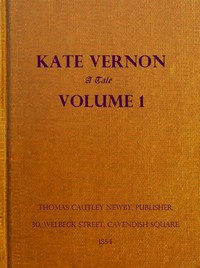
Kate Vernon: A Tale. Vol. 1 (of 3)
Written by Mrs. Alexander
Chaptra reads alongside you — AI insights, chapter breakdowns and reader discussions for every book. Join free
About this book
Reading guide
Themes, characters and key ideas in Kate Vernon: A Tale. Vol. 1 (of 3), written by Chaptra AI.
- about 8 hours
- intermediate
- romantic
- mysterious
- social commentary
Mrs. Alexander's "Kate Vernon: A Tale. Vol. 1" is a mid-19th-century novel that plunges Captain Fred Egerton into the unfamiliar social landscape of a manufacturing town amidst economic hardship. Posted to a dreary location, Egerton finds himself captivated by the enigmatic Kate Vernon at a ball, whose natural grace stands out against the backdrop of rigid class distinctions. Their initial playful encounter, born from a mistaken identity, ignites a determined pursuit by Egerton to unravel her true identity and the depth of their connection. The narrative expertly weaves together themes of burgeoning romance, the complexities of social standing, and the clash between military and civilian life, setting the stage for a compelling exploration of love and ambition in a class-conscious society.
“"The dreary autumn, with its persistent rain and grey skies, seemed but a fitting mood for a town so heavily impacted by the relentless march of industry and its fickle fortunes."”
Key themes
- Love and Identity
- The central theme revolves around Captain Egerton's burgeoning romantic interest in Kate Vernon and his quest to uncover her true identity. This is not merely physical attraction but a deeper yearning to understand who she is, suggesting that true love requires knowing and accepting another's authentic self, regardless of societal labels. His pursuit challenges his own identity as a military man and his understanding of love.
- Social Class and Standing
- The novel explicitly addresses the rigid social hierarchies of the mid-19th century, particularly the tension between the military gentry and the local manufacturing society. Captain Egerton's discomfort among the townspeople and his fascination with Kate, who 'exudes a natural grace that sets her apart,' highlight how class dictates social interactions, expectations, and perceptions of worth. The mystery around Kate's standing adds another layer to this theme, as her perceived class might be a barrier to Egerton's pursuit.
- Appearances vs. Reality
- This theme is central to the initial encounter between Egerton and Kate. His mistaken belief of knowing her, coupled with her 'mysterious' nature, suggests that first impressions and societal appearances can be deceptive. Egerton's quest to uncover her identity is, in essence, a journey from superficial perception to deeper understanding, challenging the reader to look beyond surface-level judgments. The dreary town itself might also be a 'deception' masking deeper stories.
Worth discussing
How does the novel use the setting of a 'dreary autumn' and an economically struggling town to establish its mood and themes?
Chapter-by-chapter breakdowns, character arcs and the full thematic analysis come with a free account.
Discussions
No one has started one yet
Questions this book opens up
No discussions yet
Be the first to start a discussion about this book!
Sign up to start the discussionReviews
No reviews yet
Be the first to review this book!