
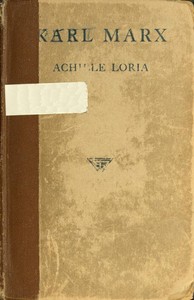
Karl Marx
Written by Achille Loria
Chaptra reads alongside you — AI insights, chapter breakdowns and reader discussions for every book. Join free
About this book
Reading guide
Themes, characters and key ideas in Karl Marx, written by Chaptra AI.
- about 12 hours
- advanced
- Analytical
- Historical
- Critical
Achille Loria's "Karl Marx" is an early 20th-century biographical and critical analysis that explores the life, intellectual development, and enduring impact of Karl Marx. The book delves into Marx's revolutionary ideas, placing them within the socio-political context that shaped his thought and rebellion against the capitalist system. Loria examines the paradox of Marx's aristocratic origins contrasting with his radical philosophy, tracing his journey from a privileged upbringing to becoming a leading intellectual agitator. The analysis also scrutinizes the inherent contradictions within Marxist theory and its reception by subsequent generations, aiming to provide a comprehensive understanding of Marx's significance.
“Specific quotes from Loria's text are not available from the provided summary. The book likely contains analytical statements about Marx's theories and biographical observations.”
Key themes
- Critique of Capitalism and Revolutionary Philosophy
- Central to Loria's analysis is the exploration of Marx's revolutionary ideas, particularly his critique of the capitalist system. The book details how Marx developed a comprehensive philosophy aimed at exposing and challenging the inherent contradictions of capitalism. This theme covers the intellectual formation of Marxism, its core tenets, and its aspiration for systemic change.
- Paradox of Origins and Rebellion
- This theme explores the striking contradiction between Karl Marx's privileged, aristocratic background and his later emergence as a radical revolutionary. Loria highlights how Marx, despite his conservative milieu and intellectual privilege, became acutely aware of societal injustices, which fueled his rebellion against established norms and ultimately shaped his critiques of the capitalist system. It delves into the personal and intellectual journey of breaking away from one's origins to embrace a revolutionary path.
- Intellectual Collaboration and Environment
- This theme highlights the crucial role of intellectual community and a vibrant socio-political environment in the development of Marx's revolutionary thought. Loria emphasizes Marx's move to Paris, where he joined a community of like-minded intellectual rebels, including figures like Engels and Proudhon. This interaction and intellectual exchange are presented as fundamental to the shaping and refinement of his philosophy, underscoring that even singular geniuses are products of their collaborative contexts.
Worth discussing
How does Loria's early 20th-century perspective on Marx differ from contemporary analyses, and what are the implications of these differences?
Chapter-by-chapter breakdowns, character arcs and the full thematic analysis come with a free account.
Discussions
No one has started one yet
Questions this book opens up
No discussions yet
Be the first to start a discussion about this book!
Sign up to start the discussionReviews
No reviews yet
Be the first to review this book!