
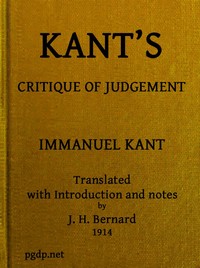
Kant's Critique of Judgement
Written by Immanuel Kant
Chaptra reads alongside you — AI insights, chapter breakdowns and reader discussions for every book. Join free
About this book
Reading guide
Themes, characters and key ideas in Kant's Critique of Judgement, written by Chaptra AI.
- about 60 hours
- advanced
- analytical
- profound
- systematic
Kant's Critique of Judgement is a seminal philosophical work that bridges the theoretical and practical realms of his critical philosophy, focusing on the faculty of judgment. It meticulously explores aesthetics, particularly our experience of beauty and the sublime, establishing their subjective yet universally communicable nature. Furthermore, the book delves into teleology, examining the concept of purposiveness in nature and how we understand organisms as self-organizing ends. Kant argues that judgment, through its reflective capacity, allows us to find coherence and meaning in the world, fostering a sense of harmony between our cognitive faculties and the natural order. This critique ultimately seeks to reconcile the mechanistic view of nature with our moral and aesthetic experiences, positing a regulative principle for understanding the world's apparent design.
“Taste is the faculty of judging an object or a method of representing it by an entirely disinterested satisfaction or dissatisfaction. The object of such satisfaction is called beautiful.”
Key themes
- Aesthetics and the Beautiful
- This theme is central to the first part of the book, where Kant meticulously analyzes the nature of aesthetic judgment, particularly our experience of beauty. He argues that judgments of beauty are subjective (based on feeling) yet lay claim to universal validity, stemming from a 'disinterested satisfaction' and the free play of imagination and understanding. This analysis introduces key concepts like 'purposiveness without purpose' and the 'sensus communis' (common sense) as the basis for shared aesthetic experience.
- The Faculty of Judgment as a Bridge
- A foundational meta-theme, Kant presents the faculty of judgment as mediating between the understanding (which provides laws for nature) and reason (which dictates moral laws and seeks unconditional freedom). Judgment, particularly reflective judgment, finds universal principles where none are given, thus harmonizing the deterministic world of phenomena with the moral demands of freedom and the aesthetic experience of beauty and purpose.
- The Sublime
- Kant distinguishes the sublime from the beautiful, describing it as an aesthetic experience that arises from encountering something vast, powerful, or formless, which initially overwhelms our imagination but ultimately elevates our reason. The sublime is divided into the mathematical (magnitude) and dynamical (power) and is linked to our capacity for moral feeling, as it demonstrates the superiority of reason over sensibility.
Worth discussing
How does Kant's distinction between determinant and reflective judgment shape his overall philosophical project?
Chapter-by-chapter breakdowns, character arcs and the full thematic analysis come with a free account.
Discussions
No one has started one yet
Questions this book opens up
No discussions yet
Be the first to start a discussion about this book!
Sign up to start the discussionReviews
No reviews yet
Be the first to review this book!