
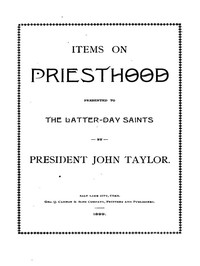
Items on the Priesthood, presented to the Latter-day Saints
Written by John Taylor
Chaptra reads alongside you — AI insights, chapter breakdowns and reader discussions for every book. Join free
About this book
Reading guide
Themes, characters and key ideas in Items on the Priesthood, presented to the Latter-day Saints, written by Chaptra AI.
- about 10 hours
- advanced
- reverent
- didactic
- authoritative
John Taylor's "Items on the Priesthood" is a foundational religious text from the late 19th century, meticulously clarifying the doctrine and function of the priesthood within The Church of Jesus Christ of Latter-day Saints. As the third president of the LDS Church, Taylor systematically outlines the distinct roles, responsibilities, and hierarchical structures of the Aaronic and Melchizedek Priesthoods. The work extensively draws upon scriptural references from the Bible and the Doctrine and Covenants to establish the divine authority and eternal nature of these priesthoods. It serves to elucidate their critical function in church governance, spiritual leadership, and ministering to members, particularly addressing uncertainties regarding the status and authority of bishops and the lesser priesthood.
“The Priesthood is the government of God, whether on the earth or in the heavens, and it is the only legitimate power by which God will govern His people.”
Key themes
- Divine Authority and Priesthood
- This is the core theme, exploring priesthood as the direct, delegated authority from God to man to act in His name. Taylor emphasizes its divine origin, its necessity for salvation, and its role as the 'government of God' on earth.
- Ecclesiastical Governance and Order
- The book meticulously details how the priesthood provides the structure and order for the Church. It explains the hierarchy from general authorities down to local leaders, ensuring proper administration and function.
- Scriptural Foundation and Revelation
- A pervasive theme is the reliance on divine revelation, both ancient (Bible) and modern (Doctrine and Covenants), as the ultimate source of truth regarding the priesthood. Taylor's arguments are consistently built upon scriptural citations.
Worth discussing
How does Taylor distinguish between the Aaronic and Melchizedek Priesthoods, and what are the implications of these distinctions for church organization?
Chapter-by-chapter breakdowns, character arcs and the full thematic analysis come with a free account.
Discussions
No one has started one yet
Questions this book opens up
No discussions yet
Be the first to start a discussion about this book!
Sign up to start the discussionReviews
No reviews yet
Be the first to review this book!