
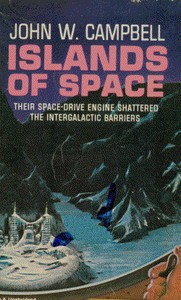
Islands of Space
Written by John W. Campbell
Chaptra reads alongside you — AI insights, chapter breakdowns and reader discussions for every book. Join free
About this book
Reading guide
Themes, characters and key ideas in Islands of Space, written by Chaptra AI.
- about 8 hours
- intermediate
- exploratory
- scientific
- adventurous
Islands of Space" by John W. Campbell Jr. chronicles the pioneering journey of brilliant scientists, led by Dr. Richard Arcot, aboard their advanced faster-than-light vessel, the "Ancient Mariner." This foundational mid-20th-century science fiction novel delves into themes of interstellar exploration, groundbreaking scientific advancement, and the potential for conflict beyond Earth. As the crew pushes the boundaries of known physics and traverses galaxies, they encounter mysterious alien ships, transforming a mission of discovery into one of cautious tension. The narrative masterfully combines speculative scientific principles with a thrilling sense of wonder and impending cosmic encounters, establishing a cornerstone for the space opera genre.
“The universe is an infinite challenge, and human ingenuity, an infinite answer.”
Key themes
- Scientific Exploration and Discovery
- The fundamental driving force of the narrative, celebrating humanity's innate desire to explore the unknown and push the boundaries of knowledge. It emphasizes the scientific method as the primary tool for understanding and conquering the universe, portraying exploration as the highest human endeavor.
- Human Ingenuity and Technological Advancement
- A central tenet of Campbell's work, this theme highlights humanity's capacity to overcome any obstacle through intellect, innovation, and technological development. The 'Ancient Mariner' itself is a symbol of this triumph, showcasing humanity's ability to master its environment and expand its reach.
- First Contact and Interspecies Relations
- The narrative pivots on the encounter with unknown alien ships, exploring the anxieties, curiosities, and potential conflicts inherent in meeting intelligent life from beyond Earth. It raises fundamental questions about xenophobia, understanding, and how humanity would react to the 'other.'
Worth discussing
How does 'Islands of Space' reflect the scientific optimism of the mid-20th century?
Chapter-by-chapter breakdowns, character arcs and the full thematic analysis come with a free account.
Discussions
No one has started one yet
Questions this book opens up
No discussions yet
Be the first to start a discussion about this book!
Sign up to start the discussionReviews
No reviews yet
Be the first to review this book!