
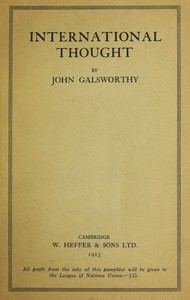
International Thought
Written by John Galsworthy
Chaptra reads alongside you — AI insights, chapter breakdowns and reader discussions for every book. Join free
About this book
Read it with a club
Small groups reading the same books and talking as they go.


News
- 4 members
- 1,813 discussions
- Active Sep 11
Read International Thought alongside people who are reading it too.
Also here: News Bulletin, Just Joking....
Chaptra Prime — paid clubs, every club feature, and unlimited reading support, for $5 a month or $60 once.
See PrimeReading guide
Themes, characters and key ideas in International Thought, written by Chaptra AI.
- about 2 hours
- advanced
- thought-provoking
- earnest
- idealistic
John Galsworthy's "International Thought" is a poignant philosophical pamphlet penned in the aftermath of World War I, reflecting the profound disillusionment with global conflict. Galsworthy argues for the critical necessity of fostering international communication and understanding to avert future wars and ensure humanity's collective salvation. He posits that destructive nationalism and competition must be overcome by an exchange of ideas among nations, emphasizing that true hope for peace resides not with governments but with influential sectors like science, finance, and the press. By promoting collaboration and recognizing shared interests, especially among professionals and intellectuals, Galsworthy advocates for a more ethical and humane approach to global challenges, championing fair play and universal engagement for a more interconnected world.
“The real hope for a peaceful future lies not in governments but in the realms of science, finance, and the press.”
Key themes
- Internationalism and Global Cooperation
- This is the central theme of the pamphlet, advocating for a world order built on mutual understanding and collaboration rather than nationalistic rivalry. Galsworthy argues that the prevention of future wars hinges on nations and individuals moving beyond narrow self-interest to embrace shared global interests.
- Critique of Nationalism and Competition
- Galsworthy directly confronts the destructive nature of unchecked nationalism and the competitive drive between nations, identifying them as primary catalysts for conflict like World War I. He critiques these forces for undermining peace and the potential for human progress.
- Role of Non-Governmental Actors (Science, Finance, Press)
- A distinctive aspect of Galsworthy's thought is his belief that the true hope for peace lies not with governments but with specific non-state sectors. He argues that science, finance, and the press possess unique, inherently international characteristics that enable them to foster global understanding and collaboration.
Worth discussing
To what extent do Galsworthy's observations about nationalism and competition remain relevant in contemporary international relations?
Chapter-by-chapter breakdowns, character arcs and the full thematic analysis come with a free account.
Discussions
No one has started one yet
Questions this book opens up
No discussions yet
Be the first to start a discussion about this book!
Sign up to start the discussionReviews
No reviews yet
Be the first to review this book!