
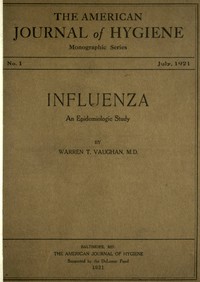
Influenza : $b An epidemiologic study
Written by Warren T. (Warren Taylor) Vaughan
Chaptra reads alongside you — AI insights, chapter breakdowns and reader discussions for every book. Join free
About this book
Reading guide
Themes, characters and key ideas in Influenza : $b An epidemiologic study, written by Chaptra AI.
- about 8 hours
- advanced
- informative
- analytical
- sober
Warren T. Vaughan's "Influenza: An Epidemiologic Study" is a seminal early 20th-century scientific monograph that meticulously examines the influenza phenomenon through an epidemiological lens. Published in the wake of the devastating 1918-1920 pandemic, the book's primary objective is to synthesize historical observations of influenza, particularly from the 1889-1893 and the recent 1918-1920 outbreaks, to identify recurring patterns and challenge prevailing misconceptions. Vaughan's work is a pioneering effort to bridge gaps in contemporary knowledge by compiling existing insights, thereby informing future public health strategies. It emphasizes the critical importance of historical epidemiological data in understanding the spread and impact of influenza, setting a rigorous foundation for combating subsequent outbreaks.
“The patterns of influenza's spread, though appearing novel in each generation, echo the experiences of the past, demanding our meticulous study.”
Key themes
- The Cyclical Nature of Pandemics
- This theme explores Vaughan's central argument that influenza outbreaks, despite their apparent novelty, follow predictable patterns across generations. By comparing the 1889-1893 pandemic with the 1918-1920 outbreak, Vaughan seeks to demonstrate commonalities in transmission, impact, and societal response, suggesting that epidemics are not isolated events but part of a recurring cycle that humanity must learn to anticipate.
- The Importance of Historical Data in Public Health
- Vaughan champions the meticulous study of historical records as an indispensable tool for understanding disease epidemiology and informing future public health strategies. He argues that by bridging knowledge gaps through the compilation of past insights, public health officials can develop more effective prevention and control measures, moving beyond reactive responses to proactive preparedness.
- Public Health Preparedness and Intervention
- Central to Vaughan's work is the imperative for effective public health strategies informed by epidemiological insights. The book serves as a call to action, advocating for proactive measures, improved surveillance, and evidence-based interventions to mitigate the impact of future outbreaks. It implicitly critiques reactive approaches and emphasizes the need for a robust public health infrastructure.
Worth discussing
How does Vaughan's early 20th-century epidemiological approach compare with modern methods of studying pandemics?
Chapter-by-chapter breakdowns, character arcs and the full thematic analysis come with a free account.
Discussions
No one has started one yet
Questions this book opens up
No discussions yet
Be the first to start a discussion about this book!
Sign up to start the discussionReviews
No reviews yet
Be the first to review this book!