
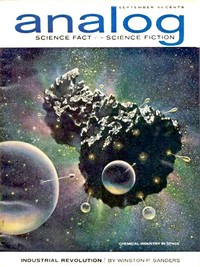
Industrial Revolution
Written by Poul Anderson
Chaptra reads alongside you — AI insights, chapter breakdowns and reader discussions for every book. Join free
About this book
Reading guide
Themes, characters and key ideas in Industrial Revolution, written by Chaptra AI.
- about 8 hours
- intermediate
- tense
- futuristic
- political
Poul Anderson's "Industrial Revolution" is a science fiction novel from the early 1960s that explores themes of colonialism, industrialization, and the struggle for independence in a futuristic asteroid belt setting. The story centers on Michael Blades and Jimmy Chung, who are building Sword Enterprises, a nascent asteroid station striving for autonomy from Earth's political and economic dominance. Their quest for self-determination is challenged by the arrival of Earth's military, represented by the battleship NASS Altair, and a mysterious missile incident that threatens their survival. Amidst political intrigue and the complexities of establishing a new society, Blades must navigate personal relationships, like his nuanced rapport with Lieutenant Ellen Ziska, to secure the future of the asteroid colonies and forge a new identity for humanity in space.
“"Freedom isn't given; it's forged, piece by piece, in the vacuum between worlds."”
Key themes
- Colonialism vs. Autonomy
- This is the central conflict of the novel, exploring the dynamics between an established power (Earth) and a developing frontier society (the asteroid belt) seeking self-governance. It delves into the justifications for control versus the inherent right to self-determination, mirroring historical decolonization movements.
- Industrialization and Technological Progress
- The novel highlights the critical role of technology and industrial development in establishing and sustaining a society in a harsh environment like the asteroid belt. It explores how innovation, resource extraction, and manufacturing become tools for survival, economic independence, and ultimately, political power.
- Identity and Nationhood
- The book delves into the psychological and sociological process of forming a new collective identity – 'asteroid nationalism' – distinct from Earth. It examines how shared struggles, common goals, and a unique environment foster a sense of belonging and purpose that transcends terrestrial origins.
Worth discussing
How does 'Industrial Revolution' reflect the geopolitical anxieties and aspirations of the early 1960s, particularly concerning decolonization and the space race?
Chapter-by-chapter breakdowns, character arcs and the full thematic analysis come with a free account.
Discussions
No one has started one yet
Questions this book opens up
No discussions yet
Be the first to start a discussion about this book!
Sign up to start the discussionReviews
No reviews yet
Be the first to review this book!