
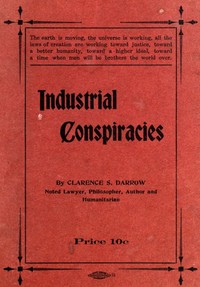
Industrial Conspiracies
Written by Clarence Darrow
Chaptra reads alongside you — AI insights, chapter breakdowns and reader discussions for every book. Join free
About this book
Read it with a club
Small groups reading the same books and talking as they go.


News
- 4 members
- 1,813 discussions
- Active Sep 11
Read Industrial Conspiracies alongside people who are reading it too.
Also here: News Bulletin, Just Joking....
Chaptra Prime — paid clubs, every club feature, and unlimited reading support, for $5 a month or $60 once.
See PrimeReading guide
Themes, characters and key ideas in Industrial Conspiracies, written by Chaptra AI.
- about 10 hours
- advanced
- analytical
- polemical
- historical
Clarence Darrow's "Industrial Conspiracies" is a seminal collection of speeches, essays, and legal arguments that fiercely advocate for labor rights and critique the inherent injustices within the American industrial and legal systems of the late 19th and early 20th centuries. Through his impassioned defense of accused labor leaders and his broader philosophical writings, Darrow dissects the power dynamics between capital and labor, exposing what he perceived as a systemic bias against the working class. The book serves as a powerful historical document, illuminating the struggles of industrial workers and Darrow's enduring fight for social justice and legal reform. It challenges conventional notions of conspiracy, arguing that collective action by workers is a necessary response to corporate oppression rather than a criminal act.
“"The greatest danger that can menace the life of any free people is the conviction among the great mass of the people that the law is not administered fairly and impartially."”
Key themes
- Social Justice and Inequality
- This is the overarching theme. Darrow relentlessly exposes and critiques the vast inequalities between industrial capitalists and the working class, arguing that the legal system often perpetuates rather than rectifies these injustices. He advocates for a more equitable society where the rights and dignity of workers are upheld.
- Class Struggle and Labor Rights
- Darrow's work is a direct engagement with the class struggle inherent in industrial capitalism. He champions the right of workers to organize, strike, and collectively bargain for better conditions, framing these actions not as criminal conspiracies but as essential means for the working class to assert its rights against powerful employers.
- The Nature of Justice and Law
- Darrow critically examines the application of law, particularly in cases involving the working class. He questions whether the law truly serves justice for all or if it is often a tool wielded by the powerful to maintain their economic and social dominance. He explores the philosophical underpinnings of legal principles versus practical outcomes.
Worth discussing
How does Darrow define 'conspiracy' in the context of labor disputes, and how does his definition challenge traditional legal interpretations?
Chapter-by-chapter breakdowns, character arcs and the full thematic analysis come with a free account.
Discussions
No one has started one yet
Questions this book opens up
No discussions yet
Be the first to start a discussion about this book!
Sign up to start the discussionReviews
No reviews yet
Be the first to review this book!