
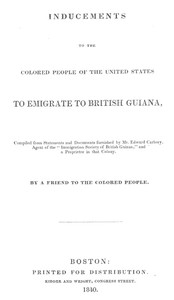
Inducements to the Colored People of the United States to Emigrate to British Guiana
Written by Richard Hildreth,Edward Carbery
Chaptra reads alongside you — AI insights, chapter breakdowns and reader discussions for every book. Join free
About this book
Reading guide
Themes, characters and key ideas in Inducements to the Colored People of the United States to Emigrate to British Guiana, written by Chaptra AI.
- about 3 hours
- intermediate
- hopeful
- informative
- persuasive
"Inducements to the Colored People of the United States to Emigrate to British Guiana" is an early 19th-century persuasive document authored by Edward Carbery (with Richard Hildreth also listed), advocating for the emigration of free colored Americans to British Guiana. The book systematically outlines the colony's geographical advantages, economic opportunities, and a supposedly non-discriminatory social environment, presenting it as a haven from racial prejudice in the United States. It details the prospects for agricultural prosperity and entrepreneurship, supported by legal protections and organized immigration assistance, including free passage. Essentially, the work functions as a promotional guide, constructing a compelling argument for British Guiana as a transformative destination where colored individuals could achieve social and economic advancement denied to them in their homeland.
“"British Guiana stands as a beacon of hope, offering what the United States denies: true equality and unfettered opportunity for colored people."”
Key themes
- Emigration as a Solution to Racial Injustice
- The central theme of the book is the proposition that emigration offers the most viable and dignified solution for free colored people escaping the pervasive racial prejudice and lack of opportunity in the United States. It frames relocation to British Guiana not just as an option, but as a path to true freedom and self-determination.
- The Promise of Economic Advancement and Self-Sufficiency
- A core inducement is the promise of economic prosperity through agriculture and entrepreneurship. The book emphasizes the fertile lands, high demand for labor, and the potential for land ownership, presenting a vision where hard work directly translates into wealth and independence, a stark contrast to the economic limitations faced by free blacks in the U.S.
- Racial Equality and Social Dignity
- Beyond economic gain, the book strongly emphasizes the social landscape of British Guiana, where colored individuals are said to participate effectively in various societal roles without the discrimination prevalent in America. This promise of social equality and dignity – the ability to live free from daily prejudice – is a powerful emotional appeal.
Worth discussing
How does the book portray British Guiana, and what rhetorical strategies does it use to make the colony appealing?
Chapter-by-chapter breakdowns, character arcs and the full thematic analysis come with a free account.
Discussions
No one has started one yet
Questions this book opens up
No discussions yet
Be the first to start a discussion about this book!
Sign up to start the discussionReviews
No reviews yet
Be the first to review this book!