
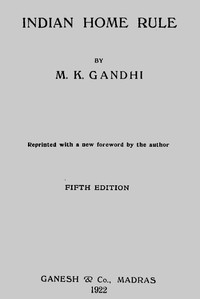
Indian Home Rule
Written by Mahatma Gandhi
Chaptra reads alongside you — AI insights, chapter breakdowns and reader discussions for every book. Join free
About this book
Reading guide
Themes, characters and key ideas in Indian Home Rule, written by Chaptra AI.
- about 8 hours
- intermediate
- philosophical
- inspirational
- didactic
“Indian Home Rule” (Hind Swaraj) by Mahatma Gandhi is a seminal political treatise advocating for India's independence from British rule through non-violent resistance. Structured as a dialogue, the work profoundly critiques Western modern civilization, arguing it is detrimental to moral and social values. Gandhi urges Indians to reject this modernity and embrace their traditional, ethical way of life, defining true Swaraj (self-rule) as not just political freedom but spiritual and moral self-mastery. He outlines a path for achieving this through civil disobedience and an unwavering commitment to ahimsa, emphasizing a collective consciousness for freedom rooted in spiritual strength and a renewal of Indian identity.
“It is Swaraj when we learn to rule ourselves.”
Key themes
- Swaraj (Self-Rule/Self-Governance)
- Gandhi's central concept, Swaraj, transcends mere political independence. It signifies true self-rule, encompassing national freedom from foreign domination, individual self-mastery, and moral sovereignty. He argues that true Swaraj requires rejecting imported Western values and institutions in favor of India's traditional ethical framework and spiritual strength.
- Non-violent Resistance (Satyagraha)
- Gandhi introduces Satyagraha, or 'truth-force,' as the only legitimate and effective means to achieve Swaraj. It is not passive resistance but active, moral resistance involving self-suffering, civil disobedience, and an unwavering commitment to truth and non-violence (Ahimsa). He argues it is a weapon of the strong, requiring immense moral courage and spiritual conviction.
- Critique of Modern Western Civilization
- Gandhi presents a scathing critique of modern civilization, viewing it as a 'sickness' or 'disease.' He argues that its emphasis on materialism, industrialization, competition, and technological progress leads to moral decay, exploitation, and spiritual emptiness. He rejects its institutions (parliament, railways, modern medicine, law) as inherently violent and detrimental to human welfare.
Worth discussing
Is Gandhi's critique of modern civilization still relevant today? In what specific ways do you see its echoes in contemporary issues?
Chapter-by-chapter breakdowns, character arcs and the full thematic analysis come with a free account.
Discussions
No one has started one yet
Questions this book opens up
No discussions yet
Be the first to start a discussion about this book!
Sign up to start the discussionReviews
No reviews yet
Be the first to review this book!