
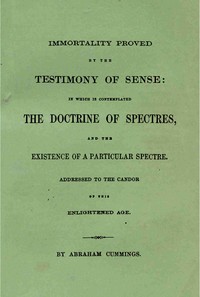
Immortality proved by the testimony of sense : $b In which is contemplated the doctrine of spectres and the existence of a particular spectre
Written by Abraham Cummings
Chaptra reads alongside you — AI insights, chapter breakdowns and reader discussions for every book. Join free
About this book
Reading guide
Themes, characters and key ideas in Immortality proved by the testimony of sense : $b In which is contemplated the doctrine of spectres and the existence of a particular spectre, written by Chaptra AI.
- about 12 hours
- advanced
- Philosophical
- Didactic
- Supernatural
Abraham Cummings's "Immortality Proved by the Testimony of Sense" is a mid-19th century religious and philosophical treatise that posits the soul's immortality through an examination of spectres and supernatural occurrences. The work fundamentally argues against materialism, asserting that personal identity and consciousness endure beyond physical death. Cummings uses historical accounts, most notably a series of phenomena witnessed in Sullivan, Maine, in 1800, as empirical evidence for the existence of spirits independent of the body. He integrates biblical references and theological reasoning to support his claims, aiming to demonstrate that life after death is not merely a matter of faith but can be substantiated by sensory perception and documented events. The book thus offers a unique blend of apologetics, proto-spiritualism, and philosophical debate concerning the nature of existence.
“The persistence of consciousness beyond the corporeal frame is not a matter of faith alone, but a truth discernible by the very senses we employ to doubt it.”
Key themes
- Immortality of the Soul
- This is the central thesis of the book, directly addressed in the title. Cummings argues that personal identity and consciousness, the essence of the individual, persist beyond the death of the physical body. He seeks to provide 'proof' for this concept, moving it from the realm of pure faith to one supported by 'sense perception.'
- Materialism vs. Spiritualism
- The book is framed as a direct intellectual battle against the burgeoning philosophy of materialism, which posited that all reality, including thought and consciousness, is reducible to matter and physical processes. Cummings champions a spiritualist view, asserting the primacy and independent existence of spirit over matter, particularly in the context of human identity and life after death.
- The Supernatural and Apparitions
- The existence and manifestation of spectres and apparitions form the operational core of Cummings's argument. He treats these phenomena not as mere folklore or psychological projections but as genuine occurrences that provide concrete evidence for the existence of disembodied spirits and, by extension, the immortal soul. This theme delves into the cultural understanding and interpretation of the supernatural in the 19th century.
Worth discussing
How does Cummings attempt to bridge the gap between empirical evidence and spiritual belief? Is his methodology convincing?
Chapter-by-chapter breakdowns, character arcs and the full thematic analysis come with a free account.
Discussions
No one has started one yet
Questions this book opens up
No discussions yet
Be the first to start a discussion about this book!
Sign up to start the discussionReviews
No reviews yet
Be the first to review this book!