
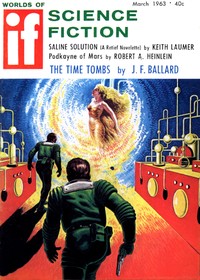
I, Executioner
Written by Terry Carr,Ted White
Chaptra reads alongside you — AI insights, chapter breakdowns and reader discussions for every book. Join free
About this book
Reading guide
Themes, characters and key ideas in I, Executioner, written by Chaptra AI.
- about 1 hours
- intermediate
- Dystopian
- Bleak
- Psychological
Ted White and Terry Carr's "I, Executioner" is a poignant science fiction short story set in a chilling dystopian future where societal order is maintained through the systematic execution of 'deviants.' The narrative follows Bob, an executioner grappling with the moral and psychological weight of his role in this cruel justice system. His internal conflict intensifies upon encountering an old friend, Rosalie, among the condemned, forcing him to confront buried memories and the true cost of his complicity. The story culminates in a harrowing psychological breakdown for Bob, exposing the fragility of sanity and identity under extreme societal pressure and questioning the very nature of enforced conformity.
“They call us executioners, but they forget we are still men, at least for a time.”
Key themes
- Societal Control and Justice
- The story profoundly explores the mechanisms of societal control in a dystopian setting, where 'justice' is a euphemism for maintaining order through brutal executions. It delves into how a governing power can define deviance and enforce conformity through fear and dehumanization, making its citizens complicit in its cruelty.
- Identity and Conformity
- The narrative deeply examines the erosion of individual identity under the pressure of societal conformity. Bob's struggle highlights how participating in a cruel system can force an individual to suppress their true self, leading to a fragmented identity where personal values clash with imposed roles. His encounter with Rosalie forces him to confront the person he once was versus the person he has become.
- Sanity and Madness
- The story expertly blurs the lines between sanity and madness, suggesting that in a truly oppressive society, what is deemed 'sane' is merely adherence to the state's brutal norms. Bob's journey questions whether true sanity can exist when one is forced to participate in or witness atrocities, ultimately implying that the refusal to conform, even if it leads to psychological collapse, might be the only 'sane' response.
Worth discussing
How does the story define 'sanity' and 'deviance' in its dystopian setting? How does this compare to real-world definitions?
Chapter-by-chapter breakdowns, character arcs and the full thematic analysis come with a free account.
Discussions
No one has started one yet
Questions this book opens up
No discussions yet
Be the first to start a discussion about this book!
Sign up to start the discussionReviews
No reviews yet
Be the first to review this book!