
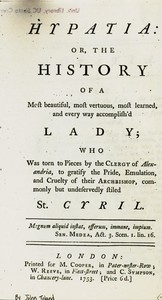
Hypatia: or, The history of a most beautiful, most vertuous, most learned, and every way accomplish'd lady; who was torn to pieces by the clergy of Alexandria, to gratify the pride, emulation, and cruelty of their archbishop, commonly but undeservedly styled St. Cyril
Written by John Toland
Chaptra reads alongside you — AI insights, chapter breakdowns and reader discussions for every book. Join free
About this book
Reading guide
Themes, characters and key ideas in Hypatia: or, The history of a most beautiful, most vertuous, most learned, and every way accomplish'd lady; who was torn to pieces by the clergy of Alexandria, to gratify the pride, emulation, and cruelty of their archbishop, commonly but undeservedly styled St. Cyril, written by Chaptra AI.
- about 8 hours
- advanced
- tragic
- polemical
- historical
John Toland's "Hypatia" is an 18th-century historical account that chronicles the life and brutal demise of Hypatia, the brilliant Alexandrian philosopher and mathematician. The book meticulously details her intellectual prowess, beauty, and prominence as a teacher, setting her against the backdrop of a declining pagan world and the ascendant, often violent, early Christian Church. Toland paints Hypatia's murder by a religious mob, instigated by Bishop Cyril, as a stark condemnation of the destructive intersection of political ambition and religious fanaticism. Through her tragic story, the work serves as a polemical critique of religious intolerance and a celebration of reason and virtue, positioning Hypatia as a timeless symbol of persecuted knowledge.
“"She was torn to pieces by the clergy of Alexandria, to gratify the pride, emulation, and cruelty of their archbishop, commonly but undeservedly styled St. Cyril."”
Key themes
- Reason vs. Faith/Superstition
- This is the central thematic conflict, with Hypatia representing the pinnacle of classical reason, philosophical inquiry, and scientific thought, while Bishop Cyril and his followers embody dogmatic faith, religious zealotry, and what Toland portrays as superstition and ignorance. The book argues that the triumph of the latter led to the suppression of intellectual progress.
- Abuse of Political and Religious Power
- Toland heavily critiques how religious authority, particularly under Bishop Cyril, can be leveraged for political gain and to suppress opposition. The book illustrates the dangerous intersection of church and state, where ecclesiastical power can overshadow secular governance and lead to extreme violence.
- Persecution of Knowledge/Intellectual Freedom
- Hypatia's murder is presented as the ultimate act of intellectual suppression. Her brilliance and independence of thought are seen as threats by the rising religious orthodoxy, leading to her violent elimination. The theme explores the historical tendency of established powers to fear and persecute those who challenge conventional wisdom or offer alternative perspectives.
Worth discussing
How does Toland's 18th-century Enlightenment perspective influence his portrayal of Hypatia, Cyril, and the events in Alexandria?
Chapter-by-chapter breakdowns, character arcs and the full thematic analysis come with a free account.
Discussions
No one has started one yet
Questions this book opens up
No discussions yet
Be the first to start a discussion about this book!
Sign up to start the discussionReviews
No reviews yet
Be the first to review this book!