
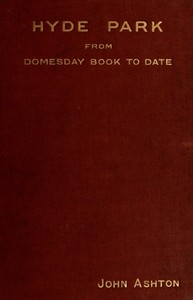
Hyde Park from Domesday-book to Date
Written by John Ashton
Chaptra reads alongside you — AI insights, chapter breakdowns and reader discussions for every book. Join free
About this book
Reading guide
Themes, characters and key ideas in Hyde Park from Domesday-book to Date, written by Chaptra AI.
- about 8 hours
- intermediate
- historical
- informative
- detailed
John Ashton's "Hyde Park from Domesday-book to Date" offers a meticulously researched historical journey through one of London's most iconic green spaces. Spanning from the medieval Domesday Book era to the late 19th century, the book chronicles Hyde Park's transformation from a royal hunting ground within a vast forest to a vital public amenity. Ashton details significant shifts in ownership, pivotal historical events, and the influence of prominent figures like Henry VIII and Elizabeth I, contextualizing the park's role within broader social and political developments. It serves as an intricate case study of urban evolution, illustrating how a geographical area can reflect and shape a city's cultural landscape through centuries of change. The narrative highlights the park's enduring importance as a site for both royal leisure and public recreation, shaping London's identity.
“From the ancient entries of the Domesday-book, we begin to trace the nascent form of what would become London's most cherished green expanse.”
Key themes
- The Evolution of Urban Spaces
- This theme explores how a significant natural area within a growing metropolis transforms over centuries due to human intervention, changing societal needs, and technological advancements. Ashton meticulously details Hyde Park's journey from a wild forest to a royal hunting ground, and ultimately to a highly managed public park, illustrating the dynamic relationship between urban development and natural landscapes.
- Power, Ownership, and Access
- This theme examines the shifting dynamics of control and accessibility regarding Hyde Park. It traces the park's transition from being an exclusive property of the Crown, used solely for royal prerogative, to becoming a space increasingly shared with and eventually owned by the public. This reflects broader shifts in political power and social rights in England.
- Leisure and Recreation
- Ashton explores how Hyde Park has served as a central venue for various forms of leisure and recreation throughout its history. This theme highlights the evolution of recreational activities, from royal hunting and aristocratic carriage drives to public promenades, sporting events, and informal gatherings, providing insight into the social customs and class structures of different eras.
Worth discussing
How does Ashton's detailed historical approach contribute to our understanding of urban development compared to more thematic or sociological studies?
Chapter-by-chapter breakdowns, character arcs and the full thematic analysis come with a free account.
Discussions
No one has started one yet
Questions this book opens up
No discussions yet
Be the first to start a discussion about this book!
Sign up to start the discussionReviews
No reviews yet
Be the first to review this book!