
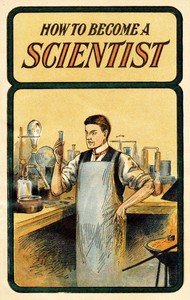
How to become a scientist : $b Giving interesting and instructive experiments in chemistry, mechanics, acoustics and pyrotechnics
Written by Aaron A. Warford
Chaptra reads alongside you — AI insights, chapter breakdowns and reader discussions for every book. Join free
About this book
Reading guide
Themes, characters and key ideas in How to become a scientist : $b Giving interesting and instructive experiments in chemistry, mechanics, acoustics and pyrotechnics, written by Chaptra AI.
- about 20 hours
- beginner
- educational
- curious
- engaging
Aaron A. Warford's "How to become a scientist" is an early 20th-century instructional guide designed to ignite scientific curiosity through engaging, hands-on experiments across chemistry, mechanics, acoustics, and pyrotechnics. The book emphasizes practical demonstrations using common materials, aiming to make complex scientific principles accessible and enjoyable for young learners and amateur enthusiasts. Through a playful and encouraging tone, it fosters a spirit of exploration and discovery, inviting readers to actively participate in scientific inquiry within their own homes. It serves as a testament to the era's approach to popular science education, blending entertainment with practical instruction to cultivate a foundational understanding of the natural world.
“The joys of exploration in science through engaging experiments.”
Key themes
- The Joy of Scientific Discovery
- This theme is central to the book's purpose, emphasizing that science is not merely a collection of facts but an exciting, hands-on journey of exploration and revelation. The book consistently highlights the pleasure derived from understanding how the world works and the wonder of witnessing scientific phenomena firsthand.
- Accessibility and Democratization of Science
- The book actively promotes the idea that science is not an exclusive domain for professionals but is accessible to everyone, regardless of formal training or specialized equipment. By focusing on experiments that can be performed with 'common materials,' it breaks down barriers to scientific engagement.
- Cultivating the Scientific Spirit
- Beyond merely teaching facts, the book aims to instill a fundamental scientific mindset—one of curiosity, observation, critical thinking, and a willingness to test hypotheses through experimentation. It encourages an active, rather than passive, engagement with the natural world.
Worth discussing
How does Warford's approach to science education compare to modern STEM curricula? What are the pros and cons of each?
Chapter-by-chapter breakdowns, character arcs and the full thematic analysis come with a free account.
Discussions
No one has started one yet
Questions this book opens up
No discussions yet
Be the first to start a discussion about this book!
Sign up to start the discussionReviews
No reviews yet
Be the first to review this book!