
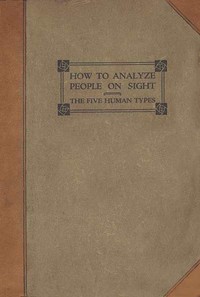
How to analyze people on sight through the science of human analysis : $b the five human types
Written by Elsie Lincoln Benedict,Ralph Paine Benedict
Chaptra reads alongside you — AI insights, chapter breakdowns and reader discussions for every book. Join free
About this book
Read it with a club
Small groups reading the same books and talking as they go.


News
- 4 members
- 1,813 discussions
- Active Sep 11
Read How to analyze people on sight through the science of human analysis : $b the five human types alongside people who are reading it too.
Also here: News Bulletin, Just Joking....
Chaptra Prime — paid clubs, every club feature, and unlimited reading support, for $5 a month or $60 once.
See PrimeReading guide
Themes, characters and key ideas in How to analyze people on sight through the science of human analysis : $b the five human types, written by Chaptra AI.
- about 7 hours
- intermediate
- Instructive
- Analytical
- Self-help
Published in the early 20th century, "How to Analyze People on Sight" by Elsie Lincoln Benedict and Ralph Paine Benedict presents a unique system for understanding human personality based on physical characteristics. The book posits that individuals can be classified into five distinct 'human types,' each with inherent traits, behaviors, and capabilities, akin to different models of automobiles. By recognizing these types in oneself and others, readers are promised enhanced self-awareness, improved interpersonal relationships, and greater personal and professional success. It functions as an early self-help guide, emphasizing the practical application of its 'science of human analysis' to foster cooperation and navigate social complexities.
“To analyze people on sight means to understand them, and to understand them means to know how to get along with them.”
Key themes
- Human Classification and Typology
- The central theme of the book is the belief that human beings can be categorized into distinct 'types' based on observable physical characteristics. This typology aims to simplify the complexities of human personality and behavior, providing a framework for understanding individual differences and predicting responses.
- Self-Understanding and Improvement
- A significant theme is the emphasis on self-knowledge as a prerequisite for personal growth and success. The book encourages readers to identify their own 'type' to better understand their inherent talents, limitations, and motivations, thereby enabling them to leverage their strengths and mitigate weaknesses.
- Pseudo-science and Physiognomy
- This theme explores the book's foundational premise that personality and behavior can be accurately 'read' or 'analyzed' through physical characteristics. It highlights the historical context of physiognomy as a popular, though scientifically unfounded, practice in the early 20th century, reflecting a societal desire for 'scientific' explanations of human nature.
Worth discussing
To what extent do physical characteristics influence our perceptions of others, even subconsciously?
Chapter-by-chapter breakdowns, character arcs and the full thematic analysis come with a free account.
Discussions
No one has started one yet
Questions this book opens up
No discussions yet
Be the first to start a discussion about this book!
Sign up to start the discussionReviews
No reviews yet
Be the first to review this book!