
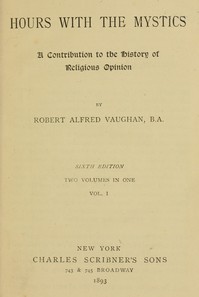
Hours with the Mystics: A Contribution to the History of Religious Opinion
Written by Robert Alfred Vaughan
Chaptra reads alongside you — AI insights, chapter breakdowns and reader discussions for every book. Join free
About this book
Reading guide
Themes, characters and key ideas in Hours with the Mystics: A Contribution to the History of Religious Opinion, written by Chaptra AI.
- about 20 hours
- advanced
- Intellectual
- Philosophical
- Historical
Robert Alfred Vaughan's "Hours with the Mystics" is a mid-19th century scholarly work that uniquely blends historical survey with a conversational framing device. The book delves into the multifaceted history and philosophy of mysticism across diverse religious traditions, exploring its manifestations from ancient times through the author's contemporary era. Through the engaging discussions of three friends—Henry Atherton, Lionel Gower, and Frank Willoughby—Vaughan examines the profound human tendency towards intense personal communion with the divine. This structure allows for a nuanced exploration of the tension between mystical experience, rational inquiry, and the emotional pursuit of religious truth, offering a comprehensive yet accessible intellectual journey into a complex subject.
“"To understand mysticism, one must first concede that the human spirit possesses avenues of apprehension beyond the mere syllogism."”
Key themes
- The Nature of Mysticism and Divine Communion
- This is the overarching theme, exploring what mysticism is, how it's defined across cultures and eras, and the various ways individuals attempt to achieve direct, intense personal communion with the divine. The book delves into the methodologies, experiences, and interpretations of this pursuit.
- Reason vs. Emotion in Religious Experience
- A central tension explored throughout the book is the relationship between rational thought and emotional or intuitive experience in understanding and pursuing religious truth. Vaughan examines how mysticism often prioritizes subjective feeling and intuition over strict logical deduction, and the historical debates arising from this contrast.
- Historical Development of Religious Opinion
- The book explicitly aims to be a 'contribution to the history of religious opinion,' tracing the evolution of mystical thought and its reception across different historical periods and cultural contexts. It examines how philosophical, theological, and societal shifts impacted the understanding and practice of mysticism.
Worth discussing
How does Vaughan's use of a conversational framing device enhance or detract from the scholarly exploration of mysticism?
Chapter-by-chapter breakdowns, character arcs and the full thematic analysis come with a free account.
Discussions
No one has started one yet
Questions this book opens up
No discussions yet
Be the first to start a discussion about this book!
Sign up to start the discussionReviews
No reviews yet
Be the first to review this book!