
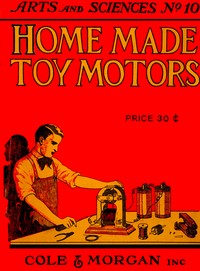
Home-made Toy Motors: A practical handbook giving detailed instructions for building simple but operative electric motors
Written by Alfred Powell Morgan
Chaptra reads alongside you — AI insights, chapter breakdowns and reader discussions for every book. Join free
About this book
Reading guide
Themes, characters and key ideas in Home-made Toy Motors: A practical handbook giving detailed instructions for building simple but operative electric motors, written by Chaptra AI.
- about 15 hours
- intermediate
- Instructive
- Empowering
- Practical
Alfred Powell Morgan's "Home-made Toy Motors" is an early 20th-century practical handbook designed to introduce readers to the fundamentals of electricity and magnetism through hands-on construction. The guide meticulously details how to build operational electric motors using accessible materials, starting with basic principles and progressively advancing to more complex designs. It serves as both an educational text and a project manual, fostering an understanding of electrical engineering and mechanical principles. Through its clear instructions and practical experiments, the book aims to empower aspiring inventors and hobbyists, demystifying the technology behind electric motors.
“The transformation of electric currents into mechanical power is a fascinating and fundamental principle.”
Key themes
- Practical Education and Hands-on Learning
- The central theme emphasizes learning by doing. Morgan advocates for direct engagement with materials and processes to understand complex scientific principles, rather than purely theoretical study. The book provides detailed instructions for constructing models, ensuring that abstract concepts of electricity and magnetism are concretized through tangible experience.
- Self-Reliance and Innovation
- The book encourages readers to become self-sufficient in their scientific pursuits, fostering a spirit of independent inquiry and problem-solving. It empowers individuals to build their own devices, promoting innovation and a 'can-do' attitude rather than relying solely on commercially produced goods. This reflects a broader cultural value of ingenuity and making.
- Democratization of Technology and Science
- Morgan's handbook makes complex electrical engineering accessible to a wider audience beyond professional engineers or academics. By providing clear, detailed instructions for building functional devices with readily available materials, it helps democratize scientific knowledge and technological understanding, fostering a broader base of scientifically literate citizens.
Worth discussing
How does 'Home-made Toy Motors' reflect the early 20th-century approach to science education compared to modern STEM curricula?
Chapter-by-chapter breakdowns, character arcs and the full thematic analysis come with a free account.
Discussions
No one has started one yet
Questions this book opens up
No discussions yet
Be the first to start a discussion about this book!
Sign up to start the discussionReviews
No reviews yet
Be the first to review this book!