
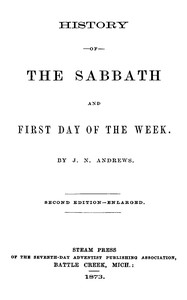
History of the Sabbath and first day of the week
Written by John Nevins Andrews
Chaptra reads alongside you — AI insights, chapter breakdowns and reader discussions for every book. Join free
About this book
Reading guide
Themes, characters and key ideas in History of the Sabbath and first day of the week, written by Chaptra AI.
- about 25 hours
- advanced
- Scholarly
- Didactic
- Historical
John Nevins Andrews' "History of the Sabbath and First Day of the Week" is a meticulous historical and theological treatise arguing for the perpetual observance of the seventh-day Sabbath. Written in the late 19th century, the book traces the Sabbath's origins from creation, asserting its divine appointment for all humanity and its reaffirmation throughout biblical history. Andrews systematically documents the historical shifts and influences, both pagan and ecclesiastical, that he posits led to the widespread adoption of Sunday observance over the divinely ordained Sabbath. The work serves as a comprehensive defense of seventh-day Sabbath keeping, aiming to restore its rightful place based on biblical and historical evidence.
“The Sabbath, then, originated with the creation, and was given to man as a memorial of the work of God.”
Key themes
- Divine Authority vs. Human Tradition
- This is the core conflict of the book. Andrews meticulously argues that the seventh-day Sabbath was divinely instituted at creation and reaffirmed by God, making it a perpetual moral obligation. He then contrasts this with Sunday observance, which he presents as a human tradition lacking biblical or divine sanction, gradually introduced and enforced by ecclesiastical and civil powers.
- Historical Continuity of God's Law
- Andrews asserts that the Sabbath command, being part of the Decalogue and instituted at creation, possesses an unchanging and eternal quality. He traces its observance as a continuous thread from Adam through the patriarchs, Israel, Christ, and the apostles, arguing that it was never abrogated but rather consistently upheld by true believers, even in the face of widespread apostasy.
- Biblical Hermeneutics and Interpretation
- Andrews' entire work is an exercise in specific biblical interpretation, emphasizing a literal and historical-grammatical approach to scripture, especially concerning the Ten Commandments and New Testament passages related to the Sabbath. He critiques alternative interpretations that suggest a change of the Sabbath or its abrogation, arguing for a consistent understanding of God's word.
Worth discussing
How does Andrews interpret biblical passages regarding the Sabbath, and do you find his interpretations convincing?
Chapter-by-chapter breakdowns, character arcs and the full thematic analysis come with a free account.
Discussions
No one has started one yet
Questions this book opens up
No discussions yet
Be the first to start a discussion about this book!
Sign up to start the discussionReviews
No reviews yet
Be the first to review this book!