
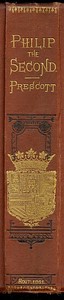
History of the Reign of Philip the Second, King of Spain, Vols. 1 and 2
Written by William Hickling Prescott
Chaptra reads alongside you — AI insights, chapter breakdowns and reader discussions for every book. Join free
About this book
Read it with a club
Small groups reading the same books and talking as they go.


News
- 4 members
- 1,813 discussions
- Active Sep 11
Read History of the Reign of Philip the Second, King of Spain, Vols. 1 and 2 alongside people who are reading it too.
Also here: News Bulletin, Just Joking....
Chaptra Prime — paid clubs, every club feature, and unlimited reading support, for $5 a month or $60 once.
See PrimeReading guide
Themes, characters and key ideas in History of the Reign of Philip the Second, King of Spain, Vols. 1 and 2, written by Chaptra AI.
- about 35 hours
- advanced
- historical
- scholarly
- epic
William H. Prescott's "History of the Reign of Philip the Second, King of Spain, Vols. 1 and 2" offers a meticulously researched and narratively engaging account of one of Europe's most influential monarchs during the tumultuous 16th century. The work delves into Philip II's ascension to power following his father Charles V's abdication, meticulously detailing the political, religious, and military landscape of Spain and Europe. Prescott masterfully interweaves biographical insights into Philip's character with broader analyses of the Reformation's impact, imperial ambitions, and the complex web of international relations. These initial volumes set the stage for Philip's long reign, establishing his unwavering commitment to Catholicism and his struggle to maintain Spanish hegemony amidst widespread dissent and foreign challenges.
“"Few monarchs have been called to a career of more brilliant promise, or to one which opened under darker auspices, than the young King of Spain."”
Key themes
- Religious Conflict and the Reformation
- This is the overarching theme, as Philip II's reign is defined by the religious strife ignited by the Protestant Reformation. Prescott details how the conflict between Catholicism and Protestantism permeated every aspect of European life, leading to wars, persecutions, and political maneuvering. Philip's unwavering commitment to defending and propagating Catholicism is central, shaping his domestic policy (e.g., the Inquisition) and foreign relations.
- Absolute Monarchy and Centralization of Power
- Prescott explores Philip II's relentless pursuit of centralized power and absolute monarchy. The book illustrates how Philip sought to govern his vast empire from his cabinet, emphasizing bureaucratic control and direct rule, often at the expense of regional autonomy and traditional liberties. This theme highlights the struggles between a monarch's desire for ultimate authority and the diverse interests of his subjects and territories.
- Imperial Ambition and European Power Dynamics
- The history vividly portrays Spain's role as the dominant European power under Philip II and the complex web of alliances, rivalries, and conflicts that characterized 16th-century international relations. Prescott details Spain's struggles against France, the Ottoman Empire, and the rising Protestant powers, illustrating the constant military and financial demands of maintaining a global empire and the strategic considerations that drove foreign policy.
Worth discussing
How does Prescott portray Philip II's character, and is this portrayal balanced or biased?
Chapter-by-chapter breakdowns, character arcs and the full thematic analysis come with a free account.
Discussions
No one has started one yet
Questions this book opens up
No discussions yet
Be the first to start a discussion about this book!
Sign up to start the discussionReviews
No reviews yet
Be the first to review this book!