
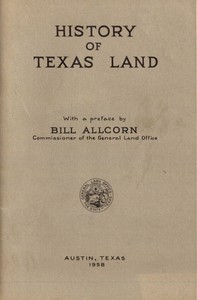
History of Texas Land
Written by Texas. General Land Office
Chaptra reads alongside you — AI insights, chapter breakdowns and reader discussions for every book. Join free
About this book
Reading guide
Themes, characters and key ideas in History of Texas Land, written by Chaptra AI.
- about 15 hours
- advanced
- informative
- historical
- official
"History of Texas Land" by the Texas General Land Office is a seminal historical account, published in the late 1950s, meticulously detailing the evolution of land ownership, acquisition, and management in Texas. The book spans from Spanish colonial rule through the mid-20th century, emphasizing land's foundational role in the state's economic development, particularly its foresight in allocating land for educational endowments like the Permanent School Fund and Permanent University Fund. It chronicles key historical junctures, including Texas's independence and U.S. annexation, illustrating how land utilization, especially through oil exploration, became inextricably linked to Texas's growth, identity, and financial stability. This authoritative text serves as a vital resource for understanding the state's unique heritage and the strategic importance of its land policies.
“The land of Texas has been, from its earliest days, the bedrock upon which its destiny has been forged.”
Key themes
- Land as a Foundational Resource
- The book consistently emphasizes land not just as territory but as the primary driver of Texas's economic, political, and social development. It details how land grants attracted settlers, how its sale funded government, and how its mineral wealth transformed the state.
- Foresight and Public Education
- A core theme is the visionary approach taken by early Texas leaders to dedicate significant portions of public land and their revenues to fund public education, creating enduring endowments like the Permanent School Fund and Permanent University Fund.
- State Sovereignty and Identity
- The book underscores Texas's unique historical position as a republic that retained its public lands upon joining the U.S., a decision that profoundly shaped its autonomy, economic power, and distinct identity. This highlights a strong sense of state self-determination.
Worth discussing
How did the unique retention of public lands by Texas upon annexation impact its subsequent development compared to other states?
Chapter-by-chapter breakdowns, character arcs and the full thematic analysis come with a free account.
Discussions
No one has started one yet
Questions this book opens up
No discussions yet
Be the first to start a discussion about this book!
Sign up to start the discussionReviews
No reviews yet
Be the first to review this book!